







What's Happening?
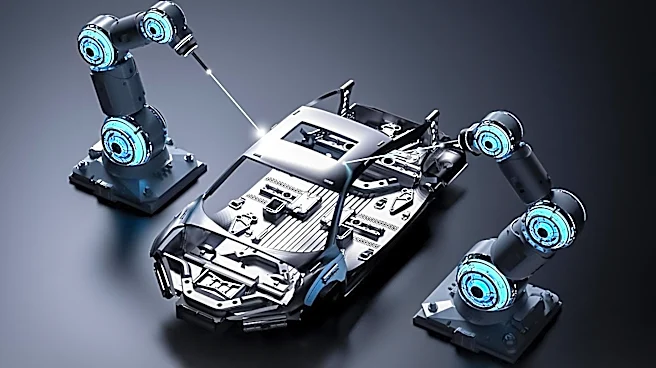
Three former SpaceX engineers have founded a startup named 1872, which officially launched on July 22 with its Factory One facility in Cincinnati, Ohio. The company aims to automate the manufacturing of steel parts using AI-driven software and robots,
with a goal of automating most of the steel fabrication process for critical infrastructure components by 2027. Initially, 1872 will focus on producing steel skids, which are rectangular steel frames used as movable foundations for modular buildings. These skids are intended for customers developing AI data centers or small modular nuclear reactors. CEO Dan Summers stated that while the company is building towards autonomy, it may not pursue full 100% automation if diminishing returns are encountered, potentially settling for around 80% autonomous operations.
Why It's Important?
This initiative directly addresses a critical challenge facing U.S. industries: a growing shortage of skilled labor, particularly in trades like welding. Industry associations have warned that this shortage could impede efforts to build essential infrastructure, including new AI data centers, semiconductor fabs, automotive factories, and shipyards. The American Welding Society projects a need for 320,500 new welding professionals by 2029 due to an aging workforce and increasing demand. By automating steel fabrication, 1872 aims to mitigate the impact of this labor gap, enabling the construction of vital infrastructure projects more efficiently. This approach could reduce production costs, accelerate project timelines, and bolster domestic manufacturing capabilities, thereby strengthening the U.S. economy and its technological leadership in areas like AI and nuclear energy.
What's Next?
Over the next 12 months, 1872 plans to significantly advance its automation efforts, focusing on both physical production and digital processes. The company has secured $15 million in seed funding, which is expected to support the launch of Factory One, the development of its automation software and hardware tech stack, and its path to profitability. Following the successful automation of steel skid manufacturing, 1872 may expand its production process to include other structural frames and enclosures. The long-term success of this model could inspire similar automation initiatives across other labor-intensive manufacturing sectors in the U.S., potentially reshaping the future of industrial production and workforce development. The company's progress will be closely watched as a case study for how automation can address skilled labor shortages in critical industries.
Beyond the Headlines
The emergence of robotic factories like 1872 highlights a broader societal and economic shift towards automation in response to demographic changes and evolving industrial demands. While automation offers solutions to labor shortages and can increase efficiency, it also raises questions about the future of human labor and the need for workforce retraining. The focus on '80 percent autonomous operations' suggests a pragmatic approach, acknowledging that full automation may not always be the most cost-effective or practical solution, and that human oversight and intervention will likely remain crucial. This development could also influence educational and vocational training programs, shifting emphasis from manual skills to robotics operation, AI management, and advanced manufacturing techniques. The success of 1872 could serve as a blueprint for how the U.S. can maintain its industrial capacity and competitiveness in an era of increasing technological advancement and demographic challenges.