



What's Happening?
Leopold Aschenbrenner, a former OpenAI researcher, has outlined a series of bold predictions regarding the future impact of artificial intelligence on the economy in a 167-page letter to investors. This letter, initially leaked to The Wall Street Journal
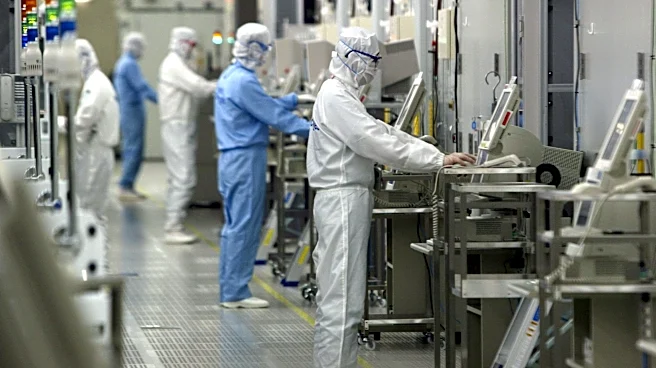
and later posted online, details Aschenbrenner's vision for how AI will reshape various major industries. Among his predictions are that Renaissance paintings will significantly increase in value, gold will become a less reliable investment due to asteroid mining, and the value of cities will diminish as robots relocate industrial hubs to remote areas. He also forecasts a decline for Nvidia, arguing that AI models will eventually design and build chips more cheaply through recursive self-improvement, rendering human engineering expertise obsolete. Conversely, Aschenbrenner remains bullish on Anthropic, the company where his wife works, predicting it could become the world's most valuable company by the end of 2027 due to its top AI talent and scalable product.
Why It's Important?
Aschenbrenner's predictions are significant because they come from a former OpenAI researcher with a track record of accurate AI-related forecasts, and his hedge fund, Situational Awareness, initially saw astronomical returns from AI stocks. His insights offer a provocative glimpse into potential future economic landscapes, challenging conventional investment wisdom and highlighting the disruptive power of AI. If his predictions materialize, they could lead to substantial shifts in asset valuations, real estate markets, and the global distribution of industrial activity. The forecast of Nvidia's decline, a current market leader, underscores the rapid pace of innovation and potential for obsolescence in the AI sector. Conversely, his bullish stance on Anthropic suggests a potential reordering of power within the AI industry. These predictions could influence investment strategies, corporate planning, and public policy discussions around AI development and its societal impact, particularly concerning job displacement and urban development.
What's Next?
Aschenbrenner's predictions, detailed in his leaked investor letter, are speculative but could influence investment strategies and market sentiment. Investors may re-evaluate their portfolios based on his forecasts, potentially shifting away from traditional safe-haven assets like gold towards art, or adjusting their positions in AI-related stocks like Nvidia and Anthropic. The broader implications for urban planning and industrial development, such as the relocation of industrial hubs by AI-powered robots, are long-term and would require significant societal and infrastructural adjustments. The continued development of AI models, particularly in recursive self-improvement, will be a key factor to watch, as it could validate Aschenbrenner's claims about the obsolescence of human engineering expertise in chip design. The performance of Anthropic in the coming years will also serve as a test of his bullish outlook on the company's potential to become the world's most valuable.
Beyond the Headlines
Beyond the immediate financial implications, Aschenbrenner's predictions raise profound questions about the future of human labor, urban living, and the very nature of value. The idea that AI could render human engineering expertise 'as obsolete as mathematicians' suggests a radical transformation of the workforce, necessitating widespread reskilling and re-evaluation of educational priorities. The predicted decline in the value of cities due to robotic industrial relocation could lead to significant demographic shifts and challenge existing infrastructure models, potentially creating new forms of inequality or opportunity. Furthermore, the revaluation of assets like Renaissance paintings over gold speaks to a potential shift in what society deems valuable in an AI-dominated world—perhaps emphasizing unique, human-created artifacts over easily reproducible commodities. These long-term shifts could trigger ethical debates about the role of AI in society, the distribution of wealth, and the preservation of human culture in an increasingly automated future.