




What's Happening?
Uber has significantly increased its investment in electric vehicle manufacturer Lucid, now holding an 11.5% stake in the company after a total investment of $500 million. This makes Uber Lucid's largest outside backer, second only to Saudi Arabia's Public
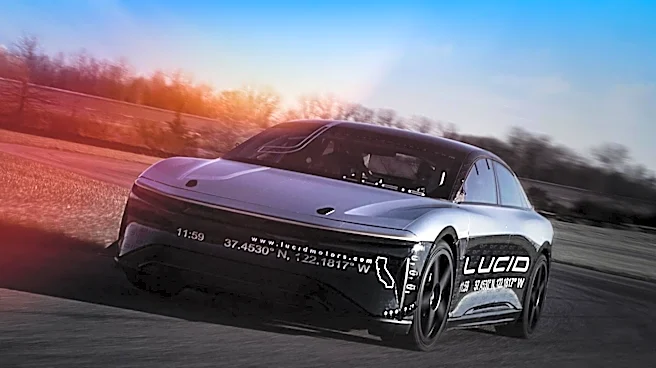
Investment Fund (PIF). The investment is directly linked to an expanded robotaxi partnership between Uber and Lucid, which also involves autonomous-driving firm Nuro. Uber initially committed $300 million in July 2025, followed by an additional $200 million in April 2026. This increased commitment also raised Uber's minimum vehicle order from Lucid for its robotaxi fleet from 20,000 to 35,000 vehicles. The robotaxi service is targeting a commercial launch in the San Francisco Bay Area later in 2026, utilizing Nuro's self-driving system integrated into Lucid vehicles, including the Gravity SUV and the unreleased Midsize platform.
Why It's Important?
This substantial investment by Uber into Lucid marks a strategic shift for the ride-sharing giant, moving beyond its traditional asset-light model of not owning cars or employing drivers. By acquiring a significant equity stake, Uber gains a seat at the table, influencing vehicle design and securing a direct financial interest in Lucid's long-term viability. This move is crucial for Uber's ambition to become a dominant dispatch and demand layer for autonomous vehicles, rather than developing its own robotaxi fleet. For Lucid, the $500 million investment provides much-needed capital, as the company has consistently burned cash since going public. The commitment for 35,000 vehicles represents a significant future revenue stream, although it is currently a promise of sales rather than immediate revenue. The success of this partnership could accelerate the adoption of robotaxis and reshape urban transportation, impacting both the automotive and ride-sharing industries.
What's Next?
The immediate next step for the partnership is the targeted commercial robotaxi launch in the San Francisco Bay Area later in 2026. Lucid has already delivered its test fleet, and on-road autonomous testing with Nuro commenced in December 2025. The success of this initial launch will be critical in validating the viability of the robotaxi model and the effectiveness of the Lucid-Nuro integration. Uber's increased vehicle commitment suggests a long-term vision for scaling this service. Lucid will need to demonstrate its ability to produce the 35,000 vehicles efficiently, particularly the more affordable Midsize platform, which is intended to be the backbone of the robotaxi fleet. The financial performance of Lucid, especially its ability to manage cash burn and achieve profitability, will be closely watched by investors and stakeholders.
Beyond the Headlines
Uber's decision to invest directly in an EV manufacturer for its robotaxi ambitions highlights a broader trend of convergence between technology platforms and automotive production. This move could set a precedent for other ride-sharing or logistics companies to take more direct control over their vehicle supply chains, especially as autonomous technology matures. The investment also underscores the intense competition in the robotaxi market, with players like Waymo and Tesla actively pursuing their own strategies. Uber's approach of partnering and investing, rather than building from scratch, reflects a calculated risk to gain optionality in a rapidly evolving sector. The ethical and regulatory implications of widespread robotaxi deployment, including job displacement for human drivers and safety standards for autonomous vehicles, will become increasingly prominent as these services expand.