




What's Happening?
China's economy maintained overall stability in October 2026, with official data indicating strengthening new growth drivers and an improving economic structure, supported by enhanced policy coordination. The National Bureau of Statistics (NBS) reported
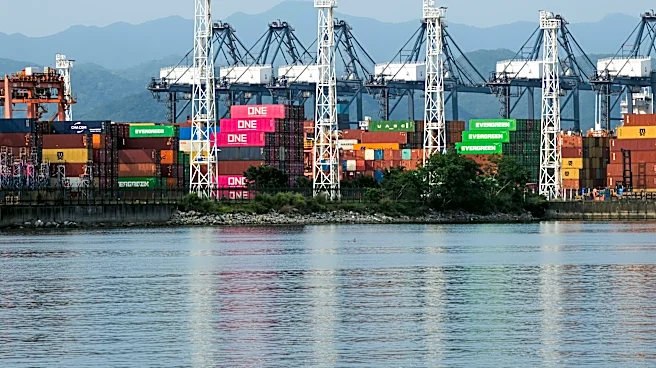
a 4.8% year-on-year rise in value-added industrial output and a 4.6% increase in the service production index. The surveyed urban unemployment rate slightly decreased to 5.1%. In the first ten months of 2026, retail sales of goods and services expanded by 2.5%, with service retail sales up 4.9%. Foreign trade was a bright spot, with goods imports and exports surging by 20% in the January-October period, and a 31.2% year-on-year climb in October alone. Trade with Belt and Road partner countries increased by 18.5%. However, fixed-asset investment dropped 8.1% year-on-year in the first ten months, and NBS spokesperson Fu Linghui cautioned about an unstable international environment, prominent domestic supply-demand imbalances, and operational difficulties for some enterprises.
Why It's Important?
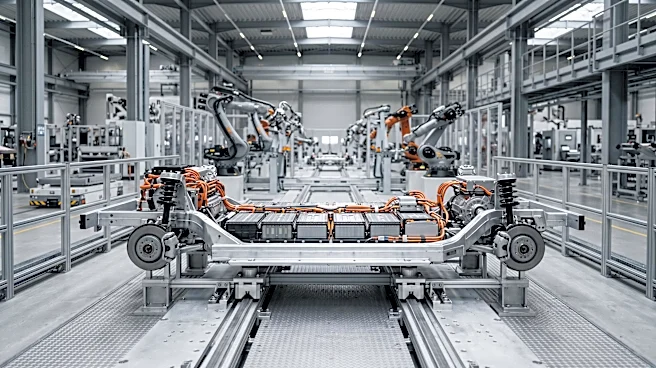
The mixed economic signals from China are important for global markets and U.S. economic stakeholders due to China's significant role in the world economy. While strong export performance, particularly in high-tech products and new energy sectors, indicates resilience and a shift towards innovation-driven growth, the decline in fixed-asset investment and ongoing domestic challenges suggest underlying vulnerabilities. The emphasis on 'new growth drivers' like high-tech manufacturing (e.g., 3D-printing equipment, lithium-ion batteries, industrial robots, new energy vehicles) signals China's strategic pivot towards advanced industries, which could intensify technological competition with the U.S. The stability in employment and consumer prices provides some reassurance, but the caution from NBS officials about external uncertainties and internal imbalances highlights potential headwinds. For U.S. businesses, China's economic health impacts supply chains, demand for goods and services, and investment opportunities, making these indicators crucial for strategic planning.
What's Next?
China's government is expected to continue efforts to ensure effective policy implementation, unleash domestic demand potential, optimize supply, deepen reform and opening up, and enhance development momentum. The focus will likely remain on fostering innovation-driven, high-quality development to achieve its full-year growth target of 4.5% to 5%. Given the unstable international environment and domestic challenges, further targeted policy adjustments or stimulus measures might be introduced to consolidate economic improvement. The continued growth in trade with Belt and Road partner countries suggests an ongoing expansion of China's economic influence globally. U.S. businesses and policymakers will closely monitor China's economic trajectory, particularly its industrial output and trade figures, as these will influence global commodity prices, supply chain stability, and the broader geopolitical landscape. The shift towards high-tech manufacturing also indicates future areas of competition and potential collaboration.
Beyond the Headlines
Beyond the immediate economic figures, China's economic performance reflects a deeper strategic reorientation towards self-reliance and high-quality development, moving away from traditional investment-led growth. The significant growth in high-tech manufacturing and exports of 'new three' products (photovoltaic products, lithium-ion batteries, and electric vehicles) indicates a deliberate effort to dominate future industries, which has profound implications for global technological leadership and competition. This shift could lead to increased trade tensions with countries like the U.S. as China aims to reduce its reliance on foreign technology and expand its market share in advanced sectors. The caution regarding domestic supply-demand imbalances also points to structural issues within the Chinese economy that policy coordination aims to address. The long-term success of these strategies will determine China's economic resilience and its role in shaping the global economic order, potentially leading to a more bifurcated global economy with distinct technological and industrial ecosystems.