






What's Happening?
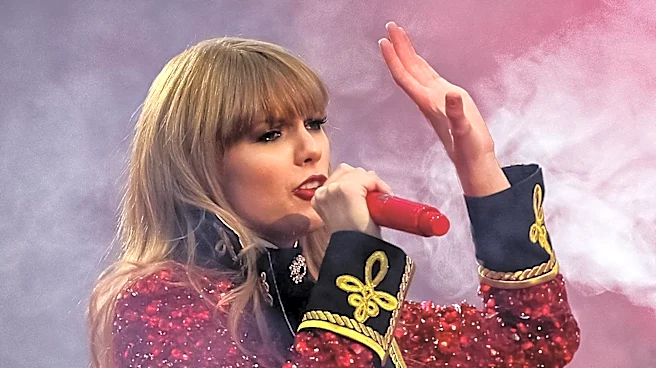
Taylor Swift's songwriting evolution is being re-evaluated, particularly in the context of her transformation into an 'NFL-affiliated megastar.' The discussion highlights how her earlier work, characterized by introspective personal narratives and a blend
of country, singer-songwriter, and pop influences, was once considered underrated. This period, spanning from post-1989 to pre-Reputation, saw Swift consistently expanding her style and imagery across albums. The article notes that while her commercial success is now virtually guaranteed, certain qualities of her songwriting have been overshadowed. It points out a shift in her approach to lead singles, citing 'ME!' from 2019 as the last time she pre-released music ahead of an album, a practice that previously involved increasingly 'indefensible red herrings.' The piece suggests that Swift has now transitioned into a 'legacy artist' mode, where some musicians might lean into expected qualities rather than continued experimentation.
Why It's Important?
This analysis is important for understanding the trajectory of one of the most influential figures in contemporary music. It sheds light on how an artist's immense commercial success and public persona can influence the critical perception and appreciation of their core artistic output. For the music industry, it underscores the dynamic between artistic evolution, market demands, and fan engagement. The shift in Swift's pre-release strategy for singles, moving away from what were once seen as 'red herrings,' could reflect a broader industry trend towards more controlled and impactful album rollouts. Furthermore, the comparison to emerging artists like Audrey Hobert, whose work is described as embodying the 'spark' of early Taylor Swift, highlights the cyclical nature of musical influence and the continuous search for authentic, vulnerable storytelling in pop music. This re-evaluation encourages a deeper look beyond the 'megastar' label to the foundational elements of her artistry.
What's Next?
As Taylor Swift continues in her 'legacy artist' phase, future releases and performances will likely be scrutinized through the lens of her past work and her current status. The article implies a potential for less experimentation in her music, suggesting that she might focus on solidifying the qualities that have defined her success. This could lead to a more consistent sound or thematic approach in her upcoming projects. For emerging artists like Audrey Hobert, who are drawing comparisons to Swift's earlier, more experimental phase, the path forward might involve navigating the balance between unique artistic expression and broader commercial appeal. The ongoing discussion about Swift's songwriting will likely continue to shape how her discography is interpreted and how new artists are perceived in relation to established icons.
Beyond the Headlines
The article subtly touches upon the broader cultural phenomenon of how artists are perceived and categorized over time. The concept of 'eras' in an artist's career, initially not explicitly used for Swift but now commonplace, reflects a societal need to compartmentalize and understand artistic evolution. The tension between an artist's 'pop bona fides' and their 'introspective personal narrative' speaks to the constant pressure on musicians to maintain authenticity while achieving commercial success. The comparison to bands like Ween, who defied traditional rock band decorum, suggests a deeper conversation about artistic integrity versus industry expectations. This highlights the ethical and cultural dimensions of artistic freedom and the potential for artists to either conform to or challenge established norms, ultimately influencing the long-term shifts in how music is created, consumed, and critically assessed.