






What's Happening?
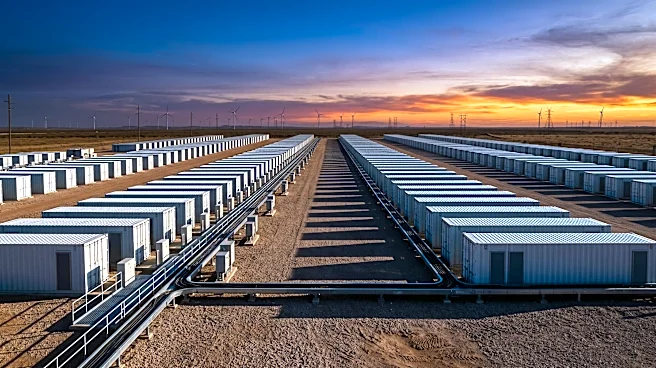
The grid-scale battery market in Texas, managed by ERCOT, has experienced a significant downturn, with revenues plummeting by over 80% in the past year. This collapse follows a period of rapid expansion, where battery capacity in the state surged from
approximately 200 megawatts at the start of the decade to 17 gigawatts today, with an additional five gigawatts expected by the end of 2026. Initially, batteries primarily generated revenue through ancillary services, accounting for over 90% of earnings in the early 2020s. However, market saturation in ancillary services has forced batteries to shift towards energy arbitrage, where they profit from price differences between charging and discharging. This increased competition has driven down prices and volatility, leading to the current financial struggles for many operators. For instance, average battery earnings dropped from nearly $200 per installed kilowatt in 2023 to around $30 in the last 12 months, a figure considered underwater for financing projects.
Why It's Important?
The financial distress in the Texas grid-scale battery market highlights critical challenges in the U.S. energy transition and infrastructure development. The rapid buildout, largely driven by a merchant model without capacity payments, demonstrates the risks of market saturation in energy-only markets. This situation impacts developers, financiers, and the broader energy sector, as it makes securing funding for new projects increasingly difficult. The decline in revenue could deter future investment in battery storage, which is crucial for grid stability and integrating renewable energy sources. Furthermore, the shift from ancillary services to energy arbitrage underscores the need for evolving market mechanisms that can sustain diverse revenue streams for energy storage technologies. The experience in Texas serves as a cautionary tale for other U.S. markets, such as PJM, which are also seeing increased battery deployment and could face similar saturation issues in their ancillary service markets.
What's Next?
The future of the Texas battery market hinges on the interplay between continued battery deployment and projected load growth, particularly from data centers. While current economics are challenging, developers are betting on a resurgence of volatility driven by an anticipated surge in demand. ERCOT's interconnection queue still holds 150-160 gigawatts of battery projects, though the rate of new additions has slowed, and a significant amount of capacity (13-15 gigawatts) has withdrawn after signing interconnection agreements. To bridge the current revenue gap, developers are increasingly seeking off-take agreements, such as tolling or revenue-sharing, to secure financing. Experts predict that significant market volatility and improved revenues may re-emerge around 2029-2030, assuming substantial data center load growth materializes and outpaces supply. However, the timing remains uncertain, and the extent to which new load growth will be met by behind-the-meter generation could impact grid volatility.
Beyond the Headlines
The situation in Texas reveals deeper implications regarding the design and evolution of electricity markets in the U.S. The 'boom and bust' cycle observed in battery storage, where initial lucrative opportunities quickly diminish due to market saturation, points to a fundamental challenge in incentivizing critical infrastructure. This cycle can lead to periods of underinvestment, potentially jeopardizing grid reliability and the pace of decarbonization. The increasing duration of batteries, from 1-hour to 2.5-3 hours, reflects an adaptation to market dynamics, aiming to capture secondary price spikes. This highlights the continuous innovation required in battery technology and operational strategies to remain competitive. The potential for large-scale data centers to incorporate on-site generation also introduces a complex variable, as it could mitigate grid demand and further suppress volatility, challenging the traditional utility model and the revenue streams for grid-connected assets.