





What's Happening?
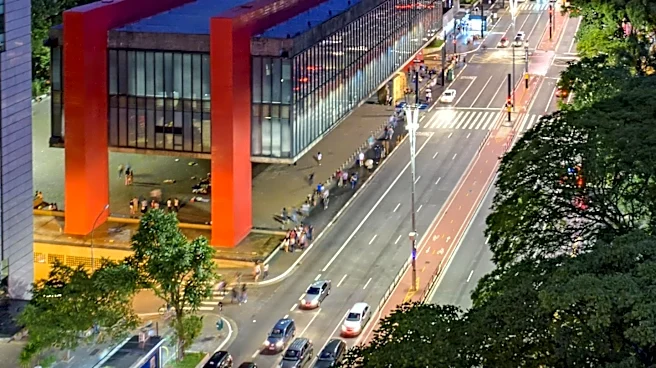
The Museu de Arte de São Paulo (MASP) is hosting an expansive exhibition titled “Histórias latino-americanas” (Latin American histories), which will run until January 31, 2027. The exhibition features 187 works by 148 artists from twenty countries, aiming
to invert colonial perspectives through its curation. One notable piece, Cecilia Vicuña’s “Sueño (Los indios matan al papa)” from 1971, depicts Indigenous figures surrounding a pope, symbolizing a moment before a siege. The exhibition is organized into sections like “The World Upside Down” and “Estamos en salsa,” which include works that use visual puns to comment on political and social themes. Luiz Armando Bagolin, an Associate Professor in Brazilian Art History, provides a critical review of the exhibition, questioning aspects of its curation and the quality disparity among the displayed works.
Why It's Important?
This exhibition at MASP holds significant cultural and academic importance, particularly for its critical re-evaluation of Latin American history through an anti-colonial lens. For U.S. academic institutions and cultural organizations, it offers a valuable case study in curatorial practices that challenge traditional narratives and promote diverse perspectives. The exhibition's focus on 'inverting' colonial viewpoints can inspire similar initiatives in U.S. museums and galleries, fostering a deeper understanding of post-colonial discourse and its artistic expressions. Furthermore, the critical analysis provided by Luiz Armando Bagolin highlights ongoing debates within art criticism regarding the balance between political messaging and artistic merit, a discussion relevant to art communities globally, including in the U.S. The sheer scale and international scope of the exhibition also underscore the growing prominence of Latin American art on the global stage, potentially influencing U.S. art markets and collection strategies.
What's Next?
The exhibition “Histórias latino-americanas” will continue to be on display at MASP until January 31, 2027, inviting ongoing public engagement and critical discourse. It is expected to draw a significant number of visitors, including art enthusiasts, academics, and students, from Brazil and internationally. The critical review by Luiz Armando Bagolin suggests that the exhibition will likely continue to be a subject of academic discussion and debate regarding its curatorial choices and the effectiveness of its thematic approach. Future scholarly articles, reviews, and possibly even academic conferences may emerge from the ongoing analysis of this extensive collection. The exhibition's long run also provides ample opportunity for educational programs and public outreach initiatives to further explore its themes.
Beyond the Headlines
Beyond its immediate artistic impact, the MASP exhibition delves into profound ethical and cultural questions about representation and historical interpretation. The concept of 'inverting the colonial perspective' challenges viewers to reconsider established power dynamics and narratives, which has broader implications for how history is taught and understood in educational systems, including those in the U.S. The critique of certain contemporary works for relying on visual puns rather than deeper artistic construction raises questions about the role of art in political commentary and whether overt messaging can sometimes overshadow artistic depth. This discussion is crucial for understanding the evolving landscape of contemporary art and its engagement with social issues. The exhibition also implicitly questions the very definition of 'Latin America' as a category, prompting reflection on how geographical and cultural labels are constructed and contested.