





What's Happening?
Artificial intelligence is increasingly being integrated into various stages of the fashion industry, from initial design concepts to final product imagery. This technological shift aims to streamline processes, reduce costs, and accelerate the speed
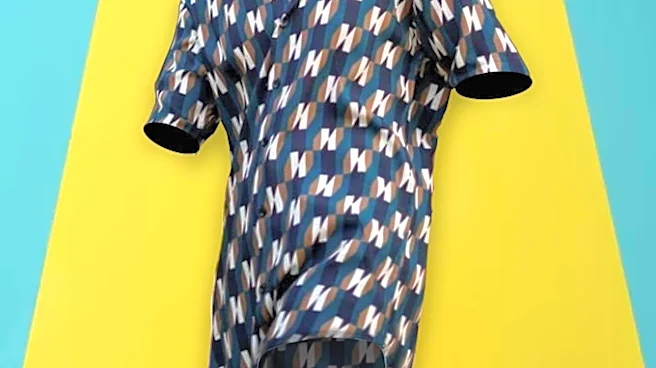
at which trends can be translated into marketable products. AI tools are now capable of spotting demand, developing early designs, simulating garments, generating technical specifications, and creating product imagery. Companies like Heuritech use AI to analyze social media imagery for trend forecasting up to 24 months in advance, while WGSN combines AI with editorial analysis for seasonal trend and design direction. For product development, platforms such as Browzwear and Style3D offer 3D garment development and simulation, significantly reducing the need for physical samples. Fynd Create assists in connecting design with sourcing and production, and The New Black provides accessible tools for concept generation and draft tech packs. These advancements are transforming how apparel brands approach design, sampling, and production, offering solutions that cater to different needs within the development process.
Why It's Important?
The integration of AI in fashion design and production holds significant importance for the U.S. apparel industry by enhancing efficiency and competitiveness. Brands can now respond to rapidly changing consumer trends with unprecedented speed, reducing the time from concept to market. This agility is crucial in a fast-paced industry where consumer preferences evolve quickly. The ability to generate draft tech packs, simulate garments in 3D, and create catalogue imagery using AI can lead to substantial cost savings in design, sampling, and prototyping. For instance, Mi Arcus reported a 35% saving in these areas after integrating Fynd. This not only benefits large enterprises but also empowers smaller design teams by providing accessible tools that level the playing field. The shift towards AI-driven processes can also lead to more sustainable practices by minimizing physical sampling and reducing waste, aligning with growing consumer demand for environmentally conscious production. Ultimately, this technological adoption can strengthen the U.S. fashion industry's position in the global market by fostering innovation and operational excellence.
What's Next?
The future of AI in fashion will likely see continued refinement and broader adoption of these tools, with a focus on seamless integration across the entire product lifecycle. As AI models become more sophisticated, they will offer even greater precision in predicting trends, optimizing designs for fit and construction, and automating more aspects of the production workflow. The development of AI Studio by CLO, currently in beta, indicates a trend towards more integrated AI capabilities within existing design software, allowing for texture generation, graphics, and rendered imagery directly from 3D designs. Brands will increasingly seek tools that offer comprehensive solutions, from ideation to production, within a single ecosystem. Furthermore, there will be a growing emphasis on the governance of AI-generated designs, data ownership, and the ethical implications of using AI in creative processes. Training and workforce adaptation will be critical as companies invest in these technologies, ensuring that human creativity remains central while AI handles repetitive or data-intensive tasks. The industry will also need to address the challenge of ensuring garment consistency across various views and revisions when using AI-generated outputs.
Beyond the Headlines
Beyond the immediate benefits of efficiency and cost reduction, the widespread adoption of AI in fashion design could trigger deeper shifts in the industry's creative and economic landscape. Ethically, questions around intellectual property and the originality of AI-generated designs will become more prominent, potentially redefining the role of human designers. The accessibility of advanced AI tools could democratize fashion design, allowing independent creators and smaller brands to compete with larger corporations by leveraging sophisticated technology without massive upfront investments. This could foster a more diverse and innovative fashion ecosystem. Culturally, the ability of AI to rapidly analyze and predict trends might lead to an acceleration of micro-trends, making fashion cycles even shorter and potentially increasing consumption, which could conflict with sustainability goals. However, AI's capacity for precision and customization could also enable a move towards 'precision over volume,' where products are tailored to individual preferences, reducing overproduction and waste. The long-term impact will depend on how the industry balances technological advancement with ethical considerations, creative integrity, and environmental responsibility.