






What's Happening?
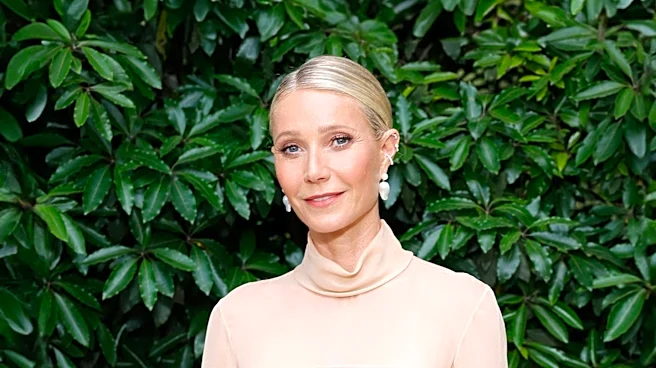
Gwyneth Paltrow recently discussed the origins of her 'conscious uncoupling' concept during her divorce from Chris Martin. In an interview on the 'Friends Keep Secrets' podcast, Paltrow explained that the idea stemmed from a desire to minimize tension
for their children, Apple and Moses, during their separation. She and Martin, who were married for 11 years, decided to end their marriage in 2014 while living in London. Paltrow consulted friends who had experienced parental divorce to understand what aspects were most damaging, finding that ongoing animosity between ex-spouses was a significant source of pain for children. This led her and Martin to work with a therapist who introduced them to the 'conscious uncoupling' framework, focusing on maintaining a family unit despite no longer being a couple. Their divorce was finalized in 2016.
Why It's Important?
Paltrow's reflection on 'conscious uncoupling' highlights a significant shift in societal approaches to divorce, particularly among public figures. Her decision to openly discuss the intentionality behind her separation from Chris Martin, and its focus on child well-being, has influenced broader conversations about amicable divorce and co-parenting. This approach challenges traditional narratives of divorce as inherently contentious, promoting a model where former spouses actively work together to mitigate negative impacts on their children. For families navigating separation, this public example provides a framework for prioritizing children's emotional health over personal grievances, potentially reducing the long-term psychological effects of divorce on younger generations. The concept, though initially met with controversy, has contributed to a more nuanced understanding of post-marital relationships.
What's Next?
The continued discussion of 'conscious uncoupling' by Gwyneth Paltrow is likely to reinforce its presence in public discourse surrounding divorce and co-parenting. As more individuals seek less adversarial ways to end marriages, the principles behind this concept may gain further traction, influencing family therapy practices and legal approaches to separation. Public figures who adopt similar strategies may also contribute to normalizing these practices. For Paltrow and Martin, their commitment to co-parenting means they will likely continue to navigate family events and milestones together, serving as an ongoing example of their chosen path. The long-term impact on their children, Apple and Moses, will be a testament to the effectiveness of their approach in fostering stable family relationships post-divorce.
Beyond the Headlines
The 'conscious uncoupling' concept, as articulated by Gwyneth Paltrow, delves into deeper ethical and cultural dimensions of family dissolution. It challenges the conventional societal expectation that divorce must be a process of severing all ties, instead advocating for a redefinition of family structure. This approach emphasizes emotional intelligence and proactive communication, suggesting that the well-being of children should supersede personal animosity. Culturally, it reflects a growing trend towards more mindful and intentional life choices, even in difficult circumstances. Legally, while 'conscious uncoupling' is not a formal legal term, its principles can inform mediation and collaborative divorce processes, encouraging settlements that prioritize ongoing parental cooperation. The concept also raises questions about the role of celebrity in shaping public perceptions of personal challenges and the potential for public figures to influence societal norms around sensitive issues like divorce.