






What's Happening?
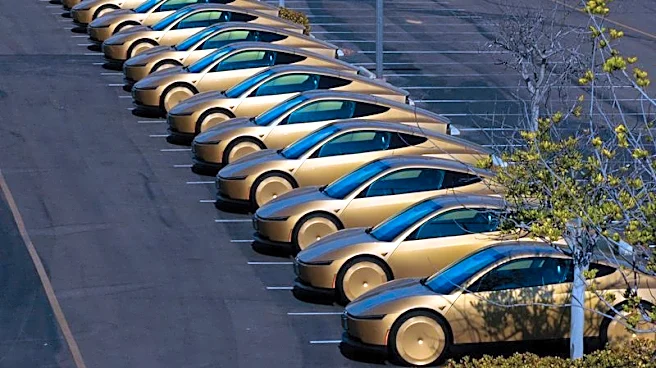
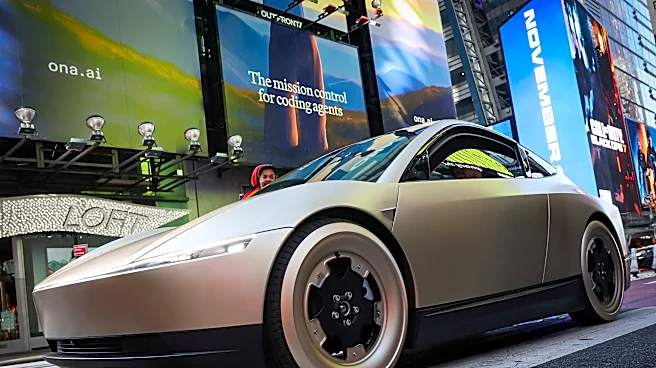
Tesla CEO Elon Musk has actively promoted the company's Cybercab ahead of its launch event in Austin, Texas, emphasizing its operational efficiency. Musk posted on X about a 'Storm of Cybercabs' and shared a meme depicting Cybercabs engulfing Austin.
He also responded to a user's comparison of Tesla Cybercabs to Waymo's robotaxis, highlighting the Cybercab's superior operational efficiency. The user's post indicated that for $1 million, one could acquire significantly more Cybercabs (estimated at $18,000 per unit by ARK Invest, though Musk previously stated around $30,000) compared to Waymo's sixth-generation Ojai robotaxis (estimated at $125,000 per unit by Morgan Stanley). Tesla's VP of Engineering, Lars Moravy, previously stated that the Cybercab has an energy consumption of 165 Wh/mi and features a 48 kWh battery, making it the most efficient EV certified.
Why It's Important?
This development is significant as Tesla aims to expand its Robotaxi network and compete in the autonomous ride-hailing market. Musk's emphasis on operational efficiency and lower unit cost for the Cybercab suggests a strategy to achieve rapid scalability and market penetration. If Tesla can deploy a large fleet of cost-effective and energy-efficient autonomous vehicles, it could disrupt traditional ride-sharing services and accelerate the adoption of self-driving technology. The comparison with Waymo highlights a potential competitive advantage for Tesla in terms of vehicle affordability and operational economics, which could influence consumer pricing and profitability in the nascent robotaxi industry. The success of Cybercab could also further solidify Tesla's position as a leader in electric vehicle innovation and autonomous driving.
What's Next?
The immediate next step is the Cybercab launch event in Austin, Texas, where more details about the vehicle's features, deployment plans, and operational specifics are expected to be revealed. Following the launch, Tesla will likely focus on scaling up production and deployment of the Cybercab fleet, initially in Austin and potentially expanding to other cities. The performance and reliability of the Cybercabs in real-world conditions will be closely watched, as will their impact on urban transportation and competition with existing ride-hailing services and other autonomous vehicle developers. Regulatory approvals for widespread autonomous operation will also be a critical factor in the Cybercab's future expansion. Investor and public reaction to the launch and initial rollout will be key indicators of its potential success.
Beyond the Headlines
The introduction of a potentially low-cost, high-efficiency robotaxi like the Cybercab could have profound long-term implications for urban planning, personal vehicle ownership, and the energy sector. A widespread robotaxi network could reduce the need for private car ownership, alleviate traffic congestion, and lower carbon emissions in cities. However, it also raises questions about job displacement for human drivers, the ethical considerations of autonomous decision-making, and the infrastructure required to support such a system. The energy consumption of these fleets, even if efficient per mile, will contribute to overall electricity demand, further emphasizing the need for sustainable energy sources. The competition between Tesla and other autonomous vehicle companies will likely drive rapid innovation and potentially reshape the future of urban mobility.