







What's Happening?
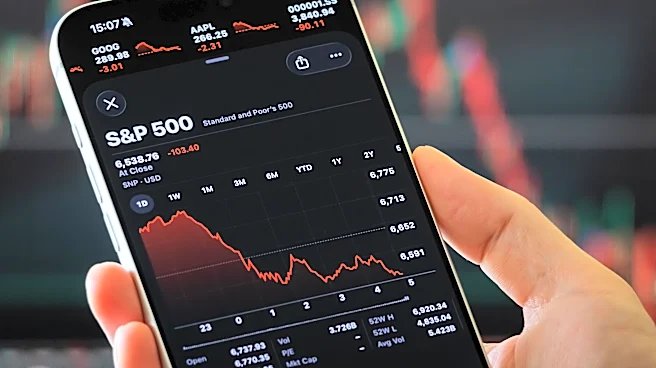
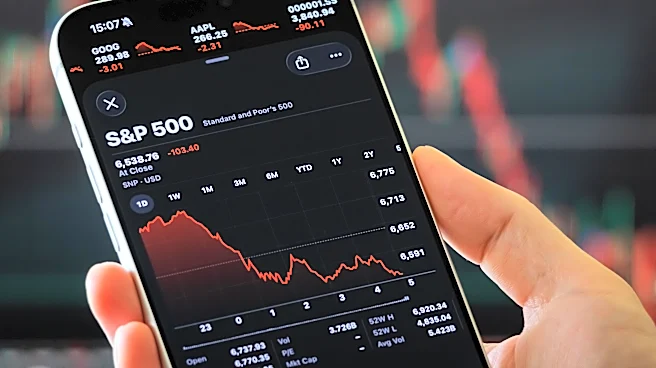
The S&P 500 recently fell to its lowest level since the 2022 bear market, with its forward price-to-earnings (P/E) ratio dropping to 16.4 on November 20, marking its cheapest reading since that period. This correction saw the index close more than 10%
below its all-time high reached in early October. Despite this downturn, the S&P 500 climbed 4.7% on November 23, the first trading day after entering correction territory. According to The Motley Fool, historical data indicates that after a 10% drop, the S&P 500 typically experiences one-year returns of 15%, three-year returns of 42%, and five-year returns of 72%. The percentage of times the index closed at a higher level one year later was 84%, which is above the historical average of 74% since 1928. The correction was attributed to previously high stock valuations, financing challenges for neoclouds and AI stocks, midterm election results indicating a strong rebuke of data center build-out, and turmoil at Nvidia.
Why It's Important?
This S&P 500 correction is significant for U.S. investors and the broader economy as it signals a potential recalibration of market valuations. While a 10% drop can trigger investor anxiety, historical patterns suggest a strong likelihood of recovery, with average one-year returns of 15% following such corrections. This indicates that investors who act decisively during downturns may find opportunities for substantial gains. The underlying strength of corporate earnings expectations, particularly driven by continued AI spending, is a crucial factor preventing a deeper bear market. The resilience of hyperscalers in investing in AI, despite financial and regulatory hurdles, underscores the ongoing technological transformation and its impact on economic growth. However, the correction also highlights the sensitivity of the market to 'bad news,' especially when valuations are high, emphasizing the need for investors to have well-defined investment theses to navigate market volatility.
What's Next?
Following the recent 4.7% climb on November 23, the S&P 500 is expected to continue its recovery, with historical data suggesting an average 15% return within a year after a 10% drop. This implies that approximately 10% in gains could still be realized over the next 249 trading days. The Motley Fool suggests that the correction is unlikely to escalate into a bear market, defined as a 20% or more fall, primarily because earnings expectations for the market remain robust. Continued AI spending by hyperscalers is anticipated to generate strong returns on invested capital, supporting market stability. Investors are advised to assess their investment theses to determine if the sell-off presents an opportunity to capitalize on market fear or if their forecasts need adjustment. The market's response to future economic data, regulatory developments, and corporate earnings reports will be critical in shaping the trajectory of the S&P 500 in the coming months.
Beyond the Headlines
The recent S&P 500 correction, while a common market phenomenon, underscores deeper implications regarding the interplay between technological innovation, market valuations, and investor psychology. The role of AI spending as a significant driver of corporate earnings and market resilience highlights the increasing dependence of the U.S. economy on technological advancements. The 'turmoil at Nvidia,' a central player in the AI industry, demonstrates how disruptions to key technology companies can have ripple effects across the broader market. Furthermore, the mention of 'midterm election results indicate a strong rebuke of the ongoing data center build-out, potentially leading to a slower pace and increased regulations,' points to the growing influence of political and regulatory environments on technological development and market sentiment. This suggests that future market movements will not only be dictated by economic fundamentals but also by policy decisions and public perception surrounding emerging technologies, potentially leading to shifts in investment strategies and industry landscapes.