




What's Happening?
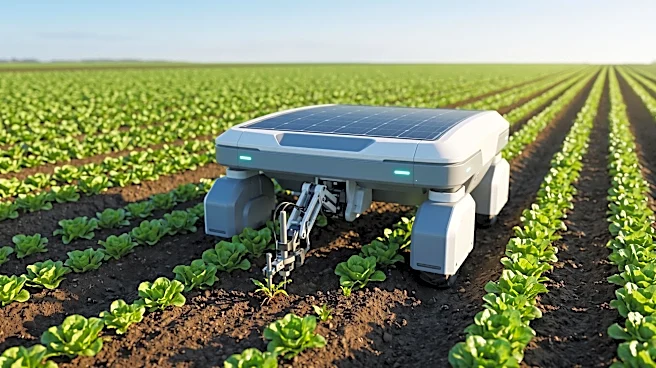
Aigen has developed a simulation and world-model system, named Alchemy, that can train its autonomous, solar-powered 'Element' agricultural robots to work with new crops in less than a week. The Alchemy platform generates synthetic, pixel-level annotated
training data, which is then used to train the Element robots before their deployment in fields. Aigen reports that an Element robot recently learned to work with lettuce in simulation and was subsequently deployed in the field within a week, demonstrating a significant reduction in the time required to adapt agricultural robots to different crops. Once deployed, the Element robots utilize onboard AI and cameras to identify crops and weeds, mechanically removing weeds at the root without the need for herbicides. These robots also collect valuable data on crop counts, plant health, and weed pressure, and can identify signs of disease and fungal infection.
Why It's Important?
This innovation by Aigen holds substantial importance for the U.S. agricultural sector. The ability to rapidly train farming robots for new crops can significantly enhance efficiency and adaptability in farming practices. By reducing reliance on herbicides and diesel, these solar-powered robots offer a more sustainable and environmentally friendly approach to agriculture, aligning with growing demands for eco-conscious farming. For U.S. farmers, this technology could lead to more stable farm budgets by reducing unpredictable costs associated with fuel and pesticides, while also improving crop management and yield. The data collection capabilities of the robots provide farmers with precise insights into their fields, enabling better decision-making and potentially increasing profitability. This advancement could help address labor shortages in agriculture and contribute to food security by optimizing crop production.
What's Next?
Aigen is currently taking orders for its Element Gen 2 X4 robots for the 2027 growing season and plans to demonstrate the Element at FIRA USA in Yakima, Washington, from October 20-22. The company has already built over 100 robots and accumulated more than 15,000 autonomous operating hours across various U.S. states, working with crops such as soybeans, tomatoes, sugarbeets, lettuce, and cotton. Fortune 500 companies are also utilizing Element Gen 2 X4 robots for weed control, agricultural data collection, and analytics. This indicates a clear path towards broader commercial adoption and integration into large-scale agricultural operations. Aigen's continued focus on scaling its technology and expanding its crop compatibility suggests a future where autonomous, AI-driven robots play a central role in sustainable farming practices.
Beyond the Headlines
The rapid development and deployment of AI-powered agricultural robots like Aigen's Element signify a deeper transformation in the food production system. This technology not only addresses immediate challenges like weed control and data collection but also contributes to the broader movement towards precision agriculture and sustainable farming. The ethical implications include the potential impact on agricultural labor, requiring workforce retraining and adaptation. Furthermore, the reliance on AI for critical farming decisions raises questions about data ownership, algorithmic bias in crop management, and the potential for technological dependencies. This shift could also lead to a re-evaluation of agricultural policies and subsidies to support the adoption of advanced robotics and AI, ultimately shaping the future of food production and environmental stewardship in the U.S. and globally.