





What's Happening?
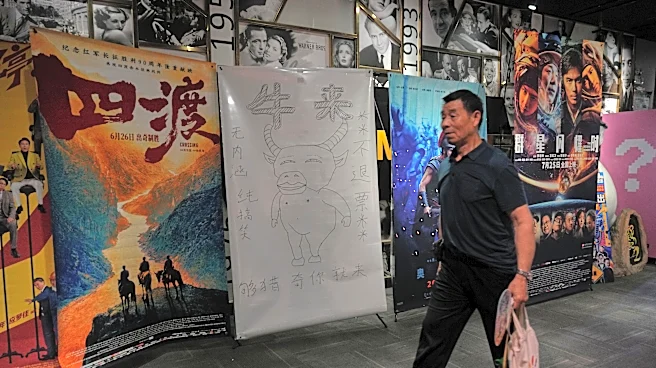
A Chinese animated film titled 'Niu Lai,' produced by a mother-and-son duo for approximately $1,000, has garnered nearly $5 million at the Chinese box office despite being removed from theaters in some regions due to its perceived low quality. Directed
by Xin Yumeng and Sun Lifang, the film tells the story of a calf named Niu Lai befriending a leopard. Initially, the film had a slow start, but it gained significant traction and went viral on social media due to posts highlighting its 'low-quality art and storytelling.' Viewers reportedly described its animation as 'worse than AI.' Despite the criticism and theatrical withdrawals, the film's unexpected financial success has made it one of the most profitable movies relative to its budget, earning over 4,000 times its production cost.
Why It's Important?
This phenomenon is important as it demonstrates the power of viral marketing and social media in the modern entertainment industry, even for productions with minimal budgets and unconventional appeal. The film's success challenges traditional notions of quality and commercial viability in cinema, suggesting that audience engagement and online buzz can sometimes outweigh critical acclaim or high production values. For the U.S. entertainment industry, this case study could inspire independent filmmakers and content creators to explore alternative distribution and marketing strategies, leveraging digital platforms to reach niche audiences and achieve unexpected financial returns. It also highlights a global trend where unique or even 'bad' content can find a significant audience, influencing how studios and distributors approach film production and promotion.
What's Next?
The unexpected success of 'Niu Lai' could lead to further exploration of low-budget, viral-driven film projects in China and potentially influence international filmmaking trends. Other independent filmmakers might attempt to replicate this model, focusing on unique concepts and leveraging social media for organic promotion, rather than relying on large marketing budgets. The film's directors, Xin Yumeng and Sun Lifang, may gain recognition for their unconventional success, potentially opening doors for future projects. The entertainment industry, both in China and globally, will likely observe how such 'cult' phenomena can be cultivated and whether this represents a sustainable model for profitability in a competitive market.
Beyond the Headlines
Beyond its financial success, 'Niu Lai' raises deeper questions about artistic merit, audience perception, and the evolving definition of 'quality' in art. The film's viral spread due to its 'bad' animation suggests a cultural shift where imperfections or unconventional aesthetics can become a source of fascination and engagement, rather than a deterrent. This phenomenon could be seen as a form of 'anti-establishment' art, challenging the dominance of high-budget, polished productions. Ethically, it prompts discussions about the role of critics versus audience sentiment in determining a film's value. Culturally, it reflects how digital platforms have democratized content creation and consumption, allowing for a wider range of artistic expressions to find an audience, regardless of traditional industry gatekeepers.