





What's Happening?
GXO Logistics, a leading logistics provider, plans to significantly accelerate its deployment of adaptive technologies, including robotics, across its U.S. operations in 2027. This phased rollout will commence at GXO’s priority sites and continue throughout
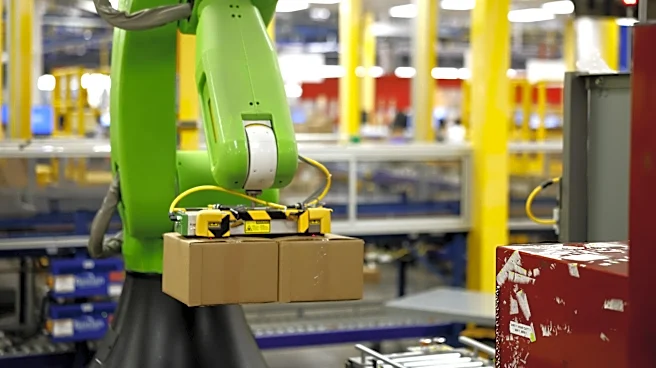
the year. The planned deployments include pallet Autonomous Mobile Robots (AMRs) to automate repetitive material transport, robotic arms for various applications like inbound unloading and packing, AI-enabled vision technologies for hands-free data capture and inventory checks, and flexible automated sortation systems. GXO aims to enhance efficiency, optimize labor resources, and improve service levels through these technological integrations. The company has also expanded partnerships with humanoid robot developers like Apptronik and Agility Robotics, with plans for a global rollout of up to 1,000 Apollo humanoids over the next four years and deployments of Digit humanoids in North Carolina and Tennessee.
Why It's Important?
GXO Logistics' aggressive investment in robotics and automation is highly significant for the U.S. logistics and supply chain industry. As one of the largest contract logistics providers, GXO's widespread adoption of advanced technologies will set new benchmarks for efficiency, productivity, and operational standards across the country. This move directly addresses critical challenges in the U.S. supply chain, such as labor shortages, rising operational costs, and the demand for faster, more accurate fulfillment. The deployment of AMRs, robotic arms, and AI-enabled vision systems will streamline warehouse operations, reduce manual errors, and improve safety. Furthermore, GXO's commitment to humanoid robots, despite acknowledging that they haven't yet produced a clear return on investment, signals a long-term vision for the future of automation that could transform how goods are handled and moved throughout the U.S. economy, impacting countless businesses and consumers.
What's Next?
The phased rollout of these adaptive technologies will begin in 2027 at GXO’s priority sites across the U.S. The company will continue to expand its partnerships with robotics providers, including Apptronik and Agility Robotics, to integrate humanoid robots into various warehouse workflows such as picking, case and tote movement, packing, and sortation. GXO will also likely continue to evaluate and deploy other automation solutions, such as automated storage and retrieval systems (ASRS) and automated trailer loading/unloading systems, as seen in its European operations. The success of these deployments will be closely monitored for key performance indicators (KPIs) and return on investment (ROI), which will inform future expansion and adoption rates across the broader logistics sector. The company's focus on continuous learning and adaptation will be crucial as these technologies mature.
Beyond the Headlines
GXO's substantial investment in robotics reflects a broader paradigm shift in the U.S. logistics industry towards hyper-automation and intelligent supply chains. This trend has profound implications for the workforce, potentially leading to a redefinition of roles and the need for new skills in managing and maintaining robotic systems. While automation can enhance efficiency and safety, it also raises questions about job displacement and the future of human labor in warehouses. The integration of humanoid robots, in particular, suggests a future where robots can perform more complex and adaptable tasks, blurring the lines between human and machine capabilities. This development will necessitate ongoing discussions among policymakers, labor unions, and businesses about workforce training, ethical AI deployment, and ensuring a just transition for workers affected by automation. The long-term impact could be a more resilient, efficient, and technologically advanced U.S. supply chain, but also one that requires careful social and economic planning.