





What's Happening?
China's economic strategy, heavily focused on dominating global high-tech manufacturing under Xi Jinping, is encountering significant headwinds and is increasingly viewed as unlikely to succeed. This approach, which involves substantial government subsidies
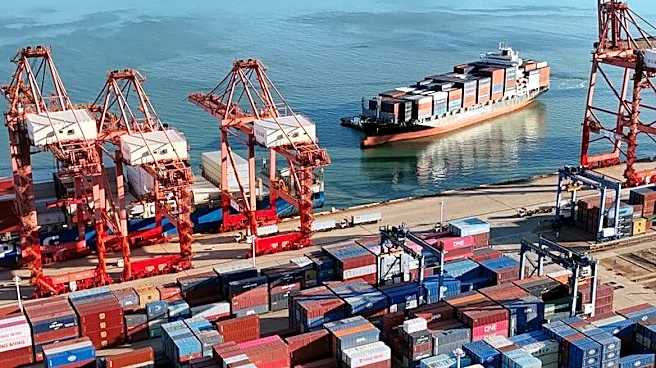
and a push to become the 'make-everything country,' is showing signs of backfiring. Despite massive industrial policy spending, China's share of global manufacturing, in U.S. dollar terms, peaked during the pandemic and has since declined. Manufacturing is also a shrinking portion of China's overall economy, making it less industrial than South Korea despite being less wealthy. The strategy relies heavily on domestic demand, which is weakening due to the ongoing real estate bust, leading to oversupply and collapsing profits in key manufacturing sectors like auto, steel, and solar. Furthermore, President Xi Jinping is perceived to have sidelined economists and purged dissenting voices within his government, potentially hindering effective policy adjustments. The country's political situation is also seen as deteriorating, with increasing paranoia leading to an inward focus.
Why It's Important?
The potential failure of China's manufacturing-centric economic model has significant implications for global trade, supply chains, and geopolitical dynamics. A slowdown in China's economic growth and its inability to achieve technological dominance could alter the balance of global power, potentially reducing the perceived urgency for aggressive counter-measures from countries like the U.S. This shift could influence trade policies, investment strategies, and military alliances, as nations reassess China's long-term economic trajectory. For U.S. industries, a less dominant China in manufacturing might create opportunities for reshoring or diversifying supply chains, reducing reliance on a single global manufacturing hub. However, it could also lead to increased global economic instability if China experiences a more severe downturn. The internal political purges and reduced influence of economic experts within China's government suggest a less adaptable and potentially more volatile economic policymaking environment, which could have ripple effects on international markets.
What's Next?
In the short term, China is likely to continue facing challenges with weak domestic demand and oversupply in its manufacturing sectors, potentially leading to further business closures and consolidation. The government's continued reliance on subsidies may prolong these issues rather than resolve them. Internationally, other countries may continue to implement tariffs and trade restrictions on Chinese products, further limiting China's export markets. The long-term outlook suggests that China's ability to adapt to new technological eras, particularly the age of artificial intelligence, may be hampered by its current centralized and less flexible system. This could lead to a slower pace of technological advancement compared to previous predictions. The ongoing political situation, characterized by President Xi Jinping's consolidation of power and suppression of dissent, indicates that policy changes are unlikely to be driven by internal economic critiques, potentially exacerbating existing problems.
Beyond the Headlines
The current economic trajectory in China highlights a broader tension between authoritarian political systems and economic adaptability. While past authoritarian regimes in China demonstrated strengths in driving economic growth, President Xi Jinping's era is illustrating the weaknesses of such systems, particularly in an environment demanding rapid technological and economic shifts. The purging of economists and the inward turn driven by 'spiraling paranoia' suggest a regime prioritizing political control over economic pragmatism. This could lead to a more insular China, less integrated into the global economy, which might have profound long-term effects on international cooperation and global governance. The reliance on a 'make-everything country' strategy, while aiming for self-sufficiency and global dominance, may ultimately lead to economic stagnation if not coupled with robust domestic demand and flexible policy responses to evolving global conditions. This situation also raises questions about the sustainability of state-led industrial policies when market forces are increasingly constrained.