




What's Happening?
Solana, a high-performance blockchain network, is increasingly being adopted by major financial companies such as Circle, Visa, PayPal, and Stripe. These firms are utilizing Solana's Layer 1 (L1) blockchain for various financial operations, including
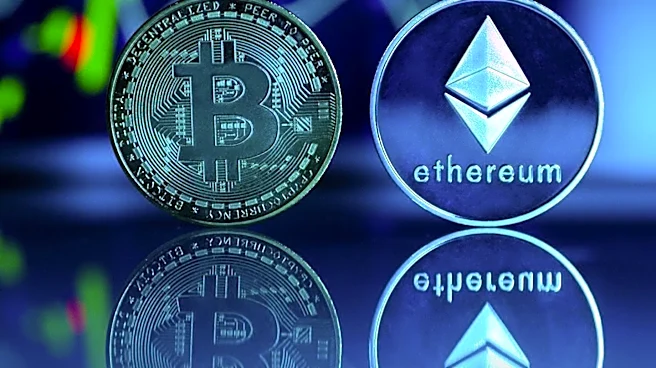
settling stablecoin transfers, tokenizing real-world assets (RWAs), launching new cryptocurrencies, and accelerating their financial transactions. Solana distinguishes itself from other blockchains like Ethereum through its proprietary proof-of-history (PoH) consensus mechanism, which timestamps transactions before validation, enabling significantly faster processing speeds. This technological advantage has positioned Solana as the second-largest developer-driven blockchain, trailing only Ethereum. The network's native token is used to cover transaction fees, making its value intrinsically linked to the expansion and activity within its ecosystem. The approval of Solana's first spot price ETFs last year further signals its growing acceptance and integration into mainstream financial markets.
Why It's Important?
Solana's rise is significant for the U.S. financial industry as it offers a high-speed, efficient alternative for blockchain-based transactions. The adoption by major players like Visa and PayPal indicates a growing confidence in blockchain technology for mainstream financial services, potentially leading to more streamlined and cost-effective operations. For businesses, Solana's capabilities can accelerate payment processing and asset tokenization, reducing settlement times and operational overheads. This shift could also impact public policy discussions around digital assets and blockchain regulation, as more established financial entities engage with these technologies. Investors stand to gain from the increased utility and adoption of Solana's network, which could drive up the value of its native token. Conversely, traditional financial intermediaries that rely on slower, more centralized systems might face pressure to adapt or risk losing market share to more agile, blockchain-integrated competitors.
What's Next?
The continued integration of Solana into the operations of major financial companies suggests a future where blockchain technology plays a more central role in global finance. As more developers and institutions leverage Solana's high-speed capabilities, its ecosystem is expected to expand further, potentially attracting even more diverse applications beyond stablecoin transfers and RWA tokenization. The success of its spot price ETFs could pave the way for similar investment products, increasing accessibility for retail and institutional investors. Regulatory bodies will likely continue to monitor the growth and use cases of Solana and other blockchain networks, potentially leading to new guidelines or frameworks to ensure market stability and consumer protection. The competition between Solana and other developer-driven blockchains like Ethereum will also intensify, driving further innovation in the space.
Beyond the Headlines
The increasing adoption of Solana by established financial giants points to a broader trend of traditional finance converging with decentralized technologies. This development challenges conventional notions of financial infrastructure and could lead to a re-evaluation of how assets are owned, transferred, and managed. Ethically, the efficiency and transparency offered by blockchain could reduce fraud and increase accountability in financial transactions, though concerns about data privacy and the environmental impact of blockchain operations remain pertinent. Legally, the tokenization of real-world assets on platforms like Solana raises complex questions about ownership, jurisdiction, and regulatory compliance, necessitating new legal frameworks. Culturally, the mainstreaming of cryptocurrencies and blockchain technology through platforms like Solana could shift public perception, moving them from niche speculative assets to integral components of the global financial system, potentially democratizing access to financial services.