




What's Happening?
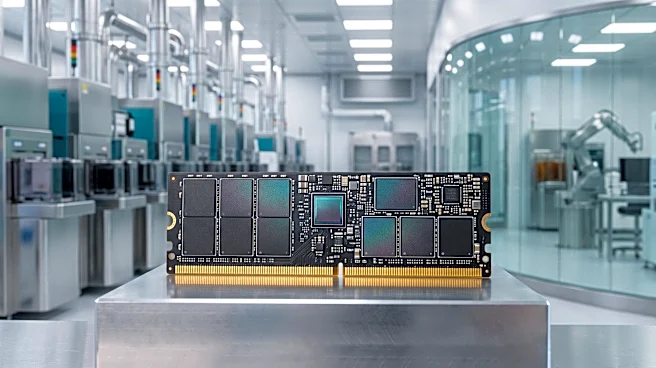
Sandisk, a flash memory maker, is experiencing significant profit growth, with non-GAAP adjusted earnings per share rising from $2.93 in fiscal Q3 2026 to $6.19 in fiscal Q1 2027. Management's guidance for fiscal Q2 projects earnings between $6.88 and $7.13.
Despite this, the company's stock, which closed at approximately $79 on November 20, 2026, after an 8-for-1 split, trades at under 3 times its annualized earnings pace. This low valuation suggests that the market anticipates a substantial decline in future earnings. Research firm TrendForce predicts an oversupply in the flash memory market in 2027, driven by factors such as reduced orders from Chinese cloud companies, less memory in consumer devices, and new production capacity. Sandisk's datacenter revenue, which reached $4.8 billion in fiscal Q1, now constitutes over 40% of its total revenue, a significant increase from $269 million a year prior.
Why It's Important?
The market's expectation of a significant drop in Sandisk's earnings, despite its current profitability, underscores the inherent volatility and cyclical nature of the flash memory industry. A projected oversupply in 2027 could lead to falling flash prices, directly impacting Sandisk's revenue and profit margins. This situation highlights the vulnerability of companies heavily dependent on commodity pricing. While Sandisk has diversified its revenue streams, particularly with its growing datacenter segment, a widespread market downturn could still significantly affect its overall financial health. For investors, this presents a complex scenario where current strong performance is overshadowed by future market uncertainties, making it challenging to accurately assess the stock's long-term value. The potential for a sharp decline in earnings could lead to significant losses for investors who do not account for these industry-specific risks.
What's Next?
The immediate focus for Sandisk and its investors will be the company's performance in fiscal Q2 2027, as guided by management. Beyond that, the flash memory market dynamics in 2027, particularly the predicted oversupply, will be critical. If flash prices fall as anticipated, Sandisk's earnings could be significantly impacted, potentially leading to a re-evaluation of its stock price. The company's ability to manage inventory, control costs, and continue growing its datacenter segment will be crucial in mitigating the effects of a market downturn. Investors will also be looking for any updates from research firms like TrendForce regarding the supply-demand balance in the flash memory market. The long-term outlook for Sandisk will depend on its resilience during potential market corrections and its strategic initiatives to navigate industry cycles.
Beyond the Headlines
The situation with Sandisk illustrates a broader economic principle: even highly profitable companies in rapidly growing sectors are not immune to market cycles and external pressures. The anticipation of an oversupply in the flash memory market highlights the global interconnectedness of supply chains and the impact of geopolitical factors (like Chinese cloud companies cutting orders) on specific industries. This scenario also brings to light the challenge of valuing companies in fast-evolving technological landscapes, where innovation and market demand can shift rapidly. The market's current skepticism towards Sandisk, despite its strong earnings, suggests a forward-looking assessment that prioritizes potential future headwinds over present successes. This could serve as a cautionary tale for investors to consider the long-term sustainability of earnings in cyclical industries, rather than solely focusing on short-term growth metrics.