



What's Happening?
Perplexity has released 'Portable Computer,' a local AI agent platform, for Windows PCs. This new offering, developed in partnership with Nvidia, allows users to run AI models, agents, and tools directly on their devices, moving beyond its previous Linux-only
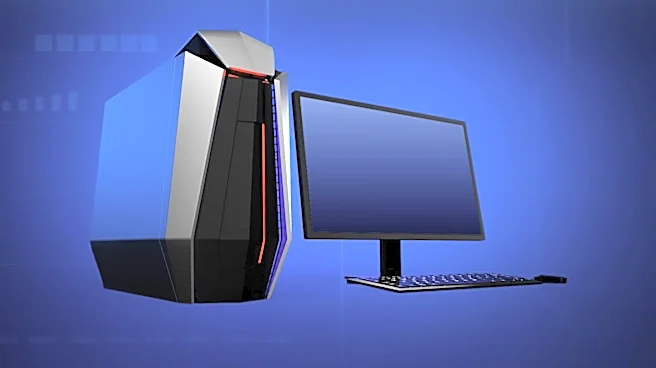
availability. Portable Computer is a local version of Perplexity Computer, designed for multi-step tasks, enabling planning, subtask execution through connectors and tools, and producing results beyond simple chat responses. A key feature is its ability to keep sensitive information secure on-device, reducing reliance on cloud computing and associated token costs. The platform requires specific hardware: a Windows PC equipped with a GeForce RTX or RTX PRO GPU that has at least 24GB of VRAM. Additionally, users need a Perplexity Pro or Max subscription to access this functionality. This development aims to provide 'unmetered local intelligence' for compatible Windows PCs, as stated by Aravind Srinivas, CEO of Perplexity.
Why It's Important?
The introduction of Perplexity's Portable Computer for Windows marks a significant shift towards on-device AI processing, particularly for professionals and businesses. By enabling local execution of AI tasks, it addresses critical concerns regarding data privacy and security, as sensitive proprietary information can remain on the user's device rather than being uploaded to the cloud. This reduces the risks associated with data breaches and compliance issues, which is crucial for industries handling confidential data. Furthermore, local processing can lead to cost savings by minimizing cloud token consumption, making advanced AI capabilities more economically viable for sustained use. The partnership with Nvidia and the specific hardware requirements highlight a growing trend of integrating powerful AI capabilities directly into high-performance computing hardware, potentially setting new standards for professional workstations. This move could empower users to leverage AI more efficiently for complex tasks without the constant need for internet connectivity or concerns about cloud service interruptions.
What's Next?
Perplexity's Portable Computer for Windows is expected to expand its features and integrations. Future developments include scheduled recurring tasks and local MCP servers for desktop applications, with Nvidia listing connectors for popular software like Microsoft Word, Google Drive, Gmail, Slack, and GitHub. This indicates a move towards deeper integration with existing professional workflows. The platform also offers a one-click option for downloading local AI models, with Qwen 3.8 27B cited as an example. Nvidia has also indicated that RTX Spark Windows PCs from manufacturers like Lenovo and Acer are anticipated to launch in October, pre-equipped with these capabilities. Support for DGX Station is also expected soon. These advancements suggest a future where more AI agents and models will be optimized for local execution on compatible hardware, potentially making advanced AI tools more accessible and efficient for a broader range of professional users.
Beyond the Headlines
This development signifies a broader trend in the technology industry towards 'edge AI' or 'on-device AI,' where computational tasks are performed closer to the data source rather than relying solely on centralized cloud infrastructure. This shift has profound implications for data governance, privacy, and the democratization of AI. By enabling local AI processing, Perplexity and Nvidia are contributing to a future where users have greater control over their data and AI applications, potentially fostering innovation in sectors with strict data handling regulations, such as healthcare, finance, and defense. It also raises questions about the future of cloud computing, suggesting a hybrid model where cloud services complement, rather than exclusively host, AI operations. The high hardware requirements, particularly the 24GB VRAM, indicate that powerful local AI capabilities will initially be accessible to a niche of professional users with high-end equipment, potentially creating a digital divide in AI access. However, as hardware evolves and AI models become more efficient, these capabilities could become more widespread, fundamentally changing how individuals and organizations interact with artificial intelligence.