







What's Happening?
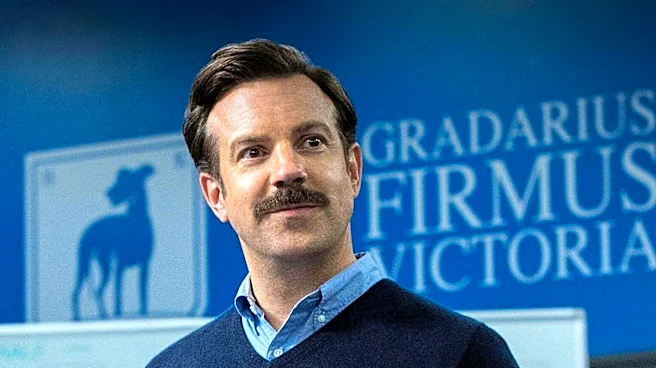
Visual effects supervisor James MacLachlan has provided insights into the extensive 'invisible effects' work undertaken for Season 4 of Apple TV's 'Ted Lasso'. In a podcast discussion, MacLachlan detailed the challenges and techniques involved in creating
the visual effects for the show. A significant portion of the work focused on the football play, including the creation of realistic crowds and stadium environments, often utilizing greenscreens. Beyond the prominent football scenes, MacLachlan also highlighted a wide array of subtle, unseen effects that were crucial to the production. These invisible effects are designed to seamlessly integrate into the live-action footage, enhancing the visual narrative without drawing explicit attention to themselves. The discussion also touched upon a specific 'meta' effect, which MacLachlan chose to keep as a surprise for listeners, indicating the creative depth of the visual effects team's contributions.
Why It's Important?
The discussion about the visual effects in 'Ted Lasso' Season 4 underscores the increasing sophistication and integral role of VFX in modern television production, even for shows not typically categorized as special effects-heavy. The concept of 'invisible effects' highlights how visual effects are used not just for fantastical elements, but also to enhance realism, create environments, and solve practical production challenges without the audience ever realizing it. This level of detail contributes significantly to the overall production value and immersive quality of the series, allowing the storytelling to remain the primary focus. For the entertainment industry, it showcases the advanced capabilities of VFX artists and studios in delivering high-quality, seamless visual enhancements that are essential for contemporary storytelling, impacting how audiences perceive the authenticity and scale of televised narratives.
What's Next?
As Season 4 of 'Ted Lasso' is released, viewers will have the opportunity to observe the subtle and overt visual effects discussed by James MacLachlan. The insights provided may encourage a more discerning viewing experience, where audiences might pay closer attention to the seamless integration of VFX in scenes, particularly those involving football matches and crowd simulations. The detailed breakdown of the visual effects process could also serve as a case study for other productions, demonstrating best practices in integrating complex VFX work into a narrative-driven series. Furthermore, the discussion about 'invisible effects' may spark broader conversations within the industry about the recognition and appreciation of VFX artists whose work often goes unnoticed due to its very nature of being seamlessly integrated into the final product.
Beyond the Headlines
The extensive use of 'invisible effects' in a show like 'Ted Lasso' reflects a broader evolution in visual storytelling, where technology is employed to create more believable and expansive worlds, even in grounded narratives. This approach blurs the lines between practical effects and digital enhancements, pushing the boundaries of what is achievable in television production. Ethically, it raises questions about the perception of reality in media, as increasingly sophisticated techniques can create environments and scenarios that are entirely digital yet appear indistinguishable from reality. Culturally, it contributes to the audience's growing expectation for high production values across all genres, influencing how stories are conceived and executed. The 'meta' effect mentioned by MacLachlan also hints at the creative freedom and innovative approaches visual effects teams are taking to engage audiences on multiple levels, adding layers of depth to the viewing experience.