
What's Happening?
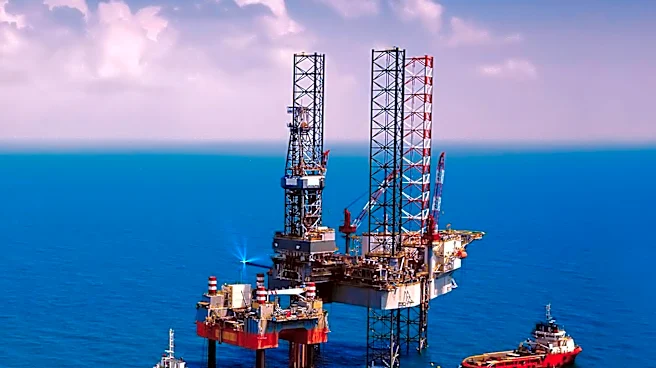
ExxonMobil Holdings Corporation has commenced oil production at its Uaru project located in Guyana. This development signifies an expansion of the company's operations within the Stabroek block, a significant
offshore oil field. The Uaru startup contributes to an increase in Guyana's overall offshore oil output capacity, adding another producing field to the existing developments in the Stabroek block. This project represents a new operational milestone for ExxonMobil in the resource-rich basin, further solidifying its role in Guyana's oil sector. ExxonMobil Holdings, a U.S.-based oil and gas producer with a market capitalization of $695.9 billion, engages in exploration and production of crude oil and natural gas across the United States, Canada, and various international basins, including Guyana's offshore fields. The company was founded in 1870 and is headquartered in Spring, Texas. It operates through several segments: Upstream, Energy Products, Chemical Products, and Specialty Products.
Why It's Important?
The initiation of production at the Uaru project is important for ExxonMobil Holdings as it reinforces the company's strategy of leveraging high-return projects in Guyana as a key production and cash engine, complementing its operations in the Permian Basin. This move aligns with ExxonMobil's narrative that technology-driven upstream growth and disciplined capital allocation can support earnings across different commodity cycles. The project highlights strong output from advantaged assets outside the Middle East, which is a crucial factor for investors. For Guyana, this expansion means increased oil output capacity and continued development of its burgeoning oil sector, potentially leading to significant economic benefits. However, the long-term impact on ExxonMobil's earnings will still depend on future oil pricing, operational performance, and successful project delivery, as earnings are currently forecast to decline over the next three years.
What's Next?
Following the Uaru project's startup, investors will closely monitor how the volumes and unit operating costs from Uaru are reflected in ExxonMobil Holdings' quarterly upstream disclosures. Management's updated guidance on Guyana's contribution to segment earnings and free cash flow, particularly through the Longtail development and other phases of the Stabroek block, will be critical. The company's ability to translate this increased capacity into sustained profits will be a key focus. Future developments in the Stabroek block will continue to shape ExxonMobil's production profile and financial performance. The broader energy market will also observe how this increased supply from Guyana impacts global oil prices and market dynamics, especially given the ongoing global energy demands and transitions.
Beyond the Headlines
The Uaru project's commencement in Guyana underscores the growing importance of offshore oil production in emerging resource-rich nations for major energy companies. This development highlights the complex interplay between global energy demand, technological advancements in extraction, and geopolitical considerations. While it provides significant economic opportunities for Guyana, it also raises questions about environmental stewardship and the long-term sustainability of fossil fuel extraction in the context of global climate change initiatives. The continued investment in large-scale oil projects by companies like ExxonMobil reflects a strategic balance between meeting current energy needs and navigating the transition to lower-emission energy sources, including the company's own pursuits in carbon capture, hydrogen, and lower-emission fuels.