




What's Happening?
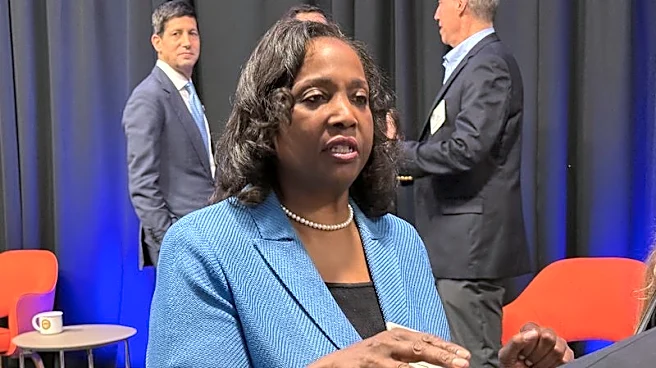
Austan Goolsbee, President and CEO of the Federal Reserve Bank of Chicago, has voiced concerns that substantial business investments in artificial intelligence (AI) data centers are contributing to an overheating U.S. economy. He noted that these investments are driving
up service prices, which he described as 'borderline disturbingly high.' Goolsbee indicated that current economic data does not suggest inflation is on a sustainable path back to the Federal Reserve's 2% annual target. He also highlighted a disparity, stating that the economic benefits derived from the AI sector are largely concentrated among a small group of stakeholders, creating a disconnect between overall market growth and the financial experiences of average Americans. This perspective aligns with broader discussions among Fed officials regarding the need for restrictive monetary policy to balance supply and demand and prevent economic overheating.
Why It's Important?
Goolsbee's remarks underscore a critical challenge for U.S. monetary policy: balancing technological advancement with economic stability. The rapid influx of capital into AI, while promising for innovation, could exacerbate inflationary pressures, particularly in the services sector. If these investments continue to fuel price increases, the Federal Reserve may be compelled to maintain or even intensify its restrictive monetary policies, potentially leading to higher interest rates for consumers and businesses. This situation could disproportionately affect sectors not directly benefiting from AI investments, widening economic inequality. The concentration of AI's economic gains among a few stakeholders also raises questions about equitable growth and the broader distribution of prosperity in an AI-driven economy, potentially leading to social and political ramifications.
What's Next?
The Federal Reserve will likely continue to closely monitor inflation data, particularly service prices, and the impact of AI investments on the broader economy. Goolsbee's comments suggest that the option of further interest rate hikes remains on the table if inflation does not show a clear and sustainable return to the 2% target. Future policy decisions by the Federal Open Market Committee (FOMC) will be heavily influenced by these economic indicators. Businesses heavily invested in AI may face increased scrutiny regarding their contribution to inflationary pressures, while policymakers might explore strategies to ensure the economic benefits of AI are more broadly distributed across the population. The ongoing debate within the Fed about the appropriate level of monetary restrictiveness will continue to shape the U.S. economic outlook.
Beyond the Headlines
The concerns raised by Austan Goolsbee extend beyond immediate economic indicators, touching upon the long-term structural changes AI could bring to the U.S. economy. The concentration of wealth and benefits from AI investments could deepen existing economic divides, potentially leading to social unrest or calls for new regulatory frameworks. Ethically, the question of who benefits from technological advancements and how these benefits are distributed will become increasingly pertinent. Legally, there might be future discussions around antitrust issues if a few companies dominate the AI landscape. Culturally, the rapid integration of AI could reshape labor markets, requiring significant workforce retraining and adaptation. These deeper implications suggest that the economic impact of AI is not merely cyclical but could represent a fundamental shift requiring comprehensive policy responses.