








What's Happening?
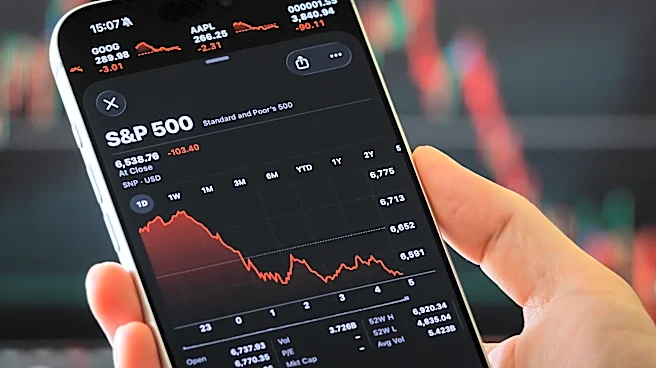
Goldman Sachs has indicated that the current selloff in the S&P 500 may not be over, despite the index sitting 12% below its October 6 record. This drop is deeper than the median 10% calendar-year decline observed since 1980. The market pain has extended
beyond artificial intelligence (AI) stocks, with Goldman's AI basket down 32% from its peak, and the index excluding AI experiencing a 6% decline. According to a note to clients, Goldman Sachs is looking for specific signals to determine when selling pressure might be exhausted. These signals include evidence that AI spending will translate into earnings, a dovish stance from the Federal Reserve regarding interest rates, or a more significant reduction in investor positioning. While hedge funds have reduced net leverage to its lowest point since April 2025, Goldman's broader positioning gauge still remains above average, suggesting further potential for market adjustments.
Why It's Important?
This warning from Goldman Sachs is significant for U.S. investors and the broader financial market, as the S&P 500 is a key indicator of the health of the U.S. economy. A continued selloff could impact retirement accounts, investment portfolios, and overall consumer confidence. The analysis highlights the ongoing uncertainty surrounding market valuations, particularly in the tech sector, and the broader economic implications of Federal Reserve policy. If the market continues its downward trend, it could lead to a more cautious investment environment, potentially affecting corporate spending and hiring. The reliance on specific signals, such as AI earnings and Federal Reserve actions, underscores the interconnectedness of technological advancements, monetary policy, and market stability. Investors will be closely watching these factors to gauge future market direction and potential opportunities or risks.
What's Next?
Investors and market participants will be closely monitoring the signals identified by Goldman Sachs to determine the future trajectory of the S&P 500. Key developments to watch include upcoming corporate earnings reports, particularly from companies heavily invested in AI, to assess whether AI spending is translating into tangible profits. The Federal Reserve's future communications and decisions regarding interest rates will also be critical, as a more 'rate-friendly' signal could provide a boost to market sentiment. Furthermore, any significant shifts in investor positioning, such as a sharper pullback in leverage, could indicate a potential bottoming out of the market. Historically, corrections of at least 10% have often been followed by gains, with the S&P 500 adding an average of 4% over three months in 73% of such episodes since 1980. Goldman's 12-month forecast for the S&P 500 is 8,700, a target set before the latest slide, suggesting a potential rebound in the longer term.
Beyond the Headlines
The current market dynamics, as highlighted by Goldman Sachs, point to a deeper re-evaluation of growth sectors, particularly those driven by emerging technologies like AI. The divergence between the performance of AI-related stocks and the broader market suggests a potential recalibration of investor expectations regarding the immediate profitability and widespread adoption of AI. This period of market volatility could also expose underlying vulnerabilities in corporate balance sheets and investment strategies that relied heavily on sustained growth in specific tech segments. The emphasis on a 'dovish' Federal Reserve signal also underscores the ongoing tension between controlling inflation and supporting economic growth, a delicate balance that has significant implications for all sectors of the U.S. economy. This environment may lead to a shift towards more value-oriented investing and a greater scrutiny of company fundamentals rather than speculative growth prospects.