
What's Happening?
Volvo Car USA has announced its partnership with Southern Living as the official automotive partner for the 2026 Southern Living Idea House in Austin, Texas. This collaboration aims to integrate Volvo's
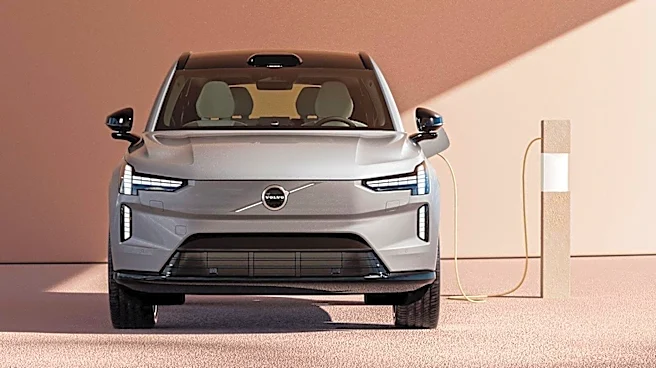
design principles and innovative technologies, particularly bi-directional charging, into the home's garage space. Designer Marcus Mohon will incorporate elements inspired by the Volvo EX60, using color, finishes, sound, and lighting to create a cohesive connection between the vehicle and its environment. The initiative will highlight Volvo's commitment to innovation, sustainability, and style. Future owners of Volvo EX90 and EX60 models in the United States will be able to utilize bi-directional charging through dcbel's Ara Home Energy Station, transforming their vehicles into versatile energy sources. This technology will enable these electric SUVs to send power back to the home, offering a solution for powering homes during blackouts and potentially reducing strain on the power grid during peak times.
Why It's Important?
This partnership signifies a notable step in the integration of automotive technology with residential infrastructure, particularly in the context of sustainable living and energy management. The showcasing of bi-directional charging at the Southern Living Idea House could accelerate public awareness and adoption of this technology, which has significant implications for the U.S. energy landscape. For consumers, it offers the potential for greater energy independence and resilience, especially during power outages. For the automotive industry, it positions electric vehicles not just as transportation but as integral components of a smart home energy ecosystem. This could drive further innovation in vehicle-to-grid (V2G) and vehicle-to-home (V2H) technologies, influencing future vehicle design and infrastructure development. The collaboration also highlights Volvo's strategic move to align its brand with sustainable and forward-thinking lifestyle trends, potentially attracting environmentally conscious consumers and strengthening its market position in the electric vehicle segment.
What's Next?
The 2026 Southern Living Idea House will serve as a prominent platform to demonstrate the practical applications and benefits of Volvo's bi-directional charging technology. Following its unveiling, there will likely be increased public discourse and interest in how electric vehicles can function as mobile power sources. This could lead to greater demand for homes equipped with compatible energy stations and for electric vehicles with bi-directional charging capabilities. Volvo will continue its electrification journey, with the EX90 and EX60 models expected to be equipped with the necessary hardware and software for this functionality. The success of this integration could also prompt other automotive manufacturers to explore similar partnerships and technological advancements, fostering a more competitive and innovative market for smart home and vehicle energy solutions. Additionally, regulatory bodies and utility companies may begin to address the implications of widespread bi-directional charging on grid management and energy policies.
Beyond the Headlines
The integration of bi-directional charging into residential settings, as demonstrated by Volvo, represents a deeper shift towards decentralized energy systems and enhanced energy resilience. This technology challenges the traditional one-way flow of electricity from grid to home, empowering homeowners to become active participants in energy management. Ethically, it raises questions about equitable access to such advanced technologies and the potential for energy disparities. Legally, it may necessitate new regulations concerning grid interconnection, energy trading, and safety standards for vehicle-to-home power transfer. Culturally, it could foster a greater appreciation for sustainable living and the role of technology in mitigating environmental impact. In the long term, this development could contribute to a more robust and flexible energy infrastructure, reducing reliance on centralized power plants and promoting a more sustainable energy future for the U.S.