







What's Happening?
IonQ, a quantum computing company, has announced a significant breakthrough in quantum error correction. The company successfully developed and tested the industry's first end-to-end real-time quantum error correction decoder that operates on a single,
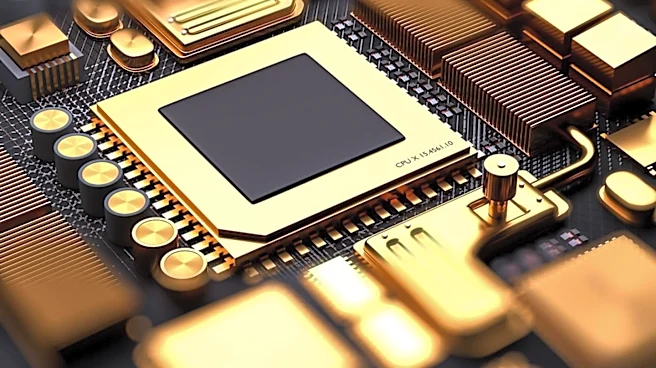
standard off-the-shelf CPU. This development challenges the long-held assumption that scaling quantum computing would necessitate vast classical computing power, specifically expensive supercomputer clusters, to manage error correction. Historically, physical qubits in quantum computers are highly susceptible to disruption, requiring researchers to group them into more stable 'logical qubits.' The data generated by these logical qubits for error correction was believed to demand immense classical processing power. IonQ's technical research paper, published on arXiv, demonstrates that a single CPU can continuously handle the complex workload of its 'Walking Cat' dual-decoder pipeline in the background, introducing only a 0.02% processing delay under standard operational noise. This was achieved while simulating 408 logical qubits across 88 memory blocks and executing 31.5 million individual quantum operations.
Why It's Important?
This milestone significantly impacts the commercial viability and scalability of quantum computing. The previous industry consensus suggested that as quantum systems scaled, the classical hardware overhead for error correction would grow exponentially, leading to unsustainable financial and computational burdens. IonQ's achievement effectively removes this 'decoder bottleneck,' proving that the challenge was an optimization problem rather than an unyielding law of physics. By demonstrating that a single standard CPU can manage real-time quantum error correction, IonQ drastically reduces the infrastructure costs associated with scaling quantum computers. This makes the path to fault-tolerant commercialization more efficient and accessible. For investors, this development strengthens the investment thesis for quantum computing companies like IonQ, as it addresses a major technical hurdle that had previously caused skepticism and valuation bottlenecks in the sector. The ability to scale without massive supercomputer investments could accelerate the development and deployment of practical quantum applications.
What's Next?
Following this breakthrough, IonQ's commercial scaling roadmap is expected to be significantly altered, allowing for more cost-effective expansion. The company's Superion 256 quantum processor is slated to be the first physically installed at Nvidia's Accelerated Quantum Research Center, connected directly to a GB200 NVL72 supercomputer via Nvidia's NVQLink, with installation anticipated in 2027. This partnership with Nvidia could further integrate IonQ's hardware with leading AI computing infrastructure, potentially opening new avenues for hybrid quantum-classical systems research. While this test was a benchmark simulation and not a physical 408-logical-qubit computer, it provides a clearer path toward the development of commercially useful, fault-tolerant quantum computers. The market has already reacted positively, with IonQ's stock seeing a significant surge, indicating increased investor confidence in the company's long-term prospects and the broader quantum computing industry.
Beyond the Headlines
This development has profound implications beyond immediate commercial scaling. It redefines the perceived limitations of quantum computing, shifting the focus from hardware-intensive solutions to software optimization. The idea that a 'computational monster' was merely a 'software problem' highlights the critical role of algorithmic and architectural innovation in advancing complex technologies. This could encourage a broader range of research and development efforts in quantum computing, potentially democratizing access to quantum capabilities by reducing the entry barrier of prohibitively expensive classical support systems. Furthermore, the integration with Nvidia's AI infrastructure suggests a future where quantum and classical computing are not just co-existing but deeply intertwined, potentially leading to novel hybrid computing paradigms that leverage the strengths of both. This could accelerate breakthroughs in fields like material science, drug discovery, and complex optimization problems, which are currently limited by classical computational power.