






What's Happening?
Daedong Gear and Daedong Robotics have announced a strategic partnership with Yiyu Robotics Technology, a Chinese firm specializing in robotic actuators, to establish a commercialization framework. This collaboration, formalized through Memorandums of
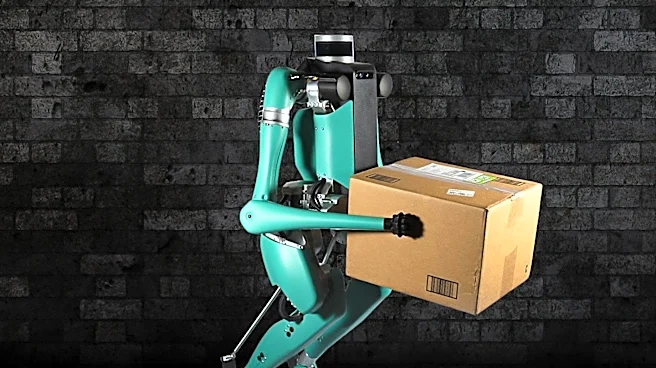
Understanding (MOUs) signed in Shanghai, aims to jointly develop, produce, and apply key robot components for agricultural humanoid robots. The initiative involves establishing a joint venture (JV) in China by January 2027 for local development and pilot production of robotic actuators. Following this, mass production is planned to shift to Korea through Daedong Gear in 2029. Daedong Robotics will then integrate these actuators into agricultural humanoid robots for performance verification and suitability testing in farm environments. The three companies have been engaged in joint actuator development since early this year, and this expanded agreement covers manufacturing, supply, application, and field testing of agricultural robots. Yiyu Robotics Technology, founded in 2018, is recognized as a leader in China for shipments of harmonic joint modules for humanoid robots.
Why It's Important?
This joint venture signifies a significant step towards advancing robotics in the agricultural sector, particularly in the development of humanoid robots capable of performing farm work. The collaboration leverages Daedong Gear's expertise in reducers and quality verification, Yiyu's strengths in motor design and actuator technologies, and Daedong Robotics' understanding of agricultural robot requirements. The move to establish mass production in Korea by 2029 indicates a long-term strategy to become a global supplier of robotic drive components, potentially reducing reliance on foreign suppliers for critical robotic parts. The application of these jointly developed actuators in agricultural humanoid robots could lead to increased automation and efficiency in farming, addressing labor shortages and improving productivity in the agricultural industry. This partnership also highlights the growing international collaboration in robotics and advanced manufacturing, with implications for technological innovation and market competition in the global robotics landscape.
What's Next?
The immediate next step is the establishment of a joint venture in China by January 2027, which will focus on the development and pilot production of robotic actuators. Following this, the companies plan to scale up manufacturing and quality capabilities, with a goal of initiating mass production in Korea through Daedong Gear in 2029. Daedong Robotics will be responsible for integrating these actuators into agricultural humanoid robots and conducting field tests to ensure their performance and suitability for farm tasks. This will involve incorporating specific work motions and load characteristics of agricultural robots into the product design and participating in motor and driver development. The success of these verification stages will be crucial for the broader commercialization and adoption of these advanced agricultural robots. The companies aim to secure technologies for integrating motors, reducers, and sensors, which will be vital for the functionality and efficiency of the robots.
Beyond the Headlines
This collaboration extends beyond mere component development; it represents a strategic effort to integrate advanced robotics into a traditionally labor-intensive sector. The focus on agricultural humanoid robots suggests a future where complex farm tasks, currently performed by humans, could be augmented or replaced by machines, potentially transforming agricultural labor markets and operational models. The emphasis on developing and manufacturing these components in Korea, after initial development in China, could also be seen as a move towards securing a domestic supply chain for critical robotics technology, enhancing national technological sovereignty. Furthermore, the development of versatile actuators could have applications beyond agriculture, potentially impacting other industries requiring precise robotic movements. The long-term implications include increased food production efficiency, reduced operational costs for farmers, and a shift in the skill sets required for agricultural work, necessitating new training and employment opportunities in robotics maintenance and operation.