




What's Happening?
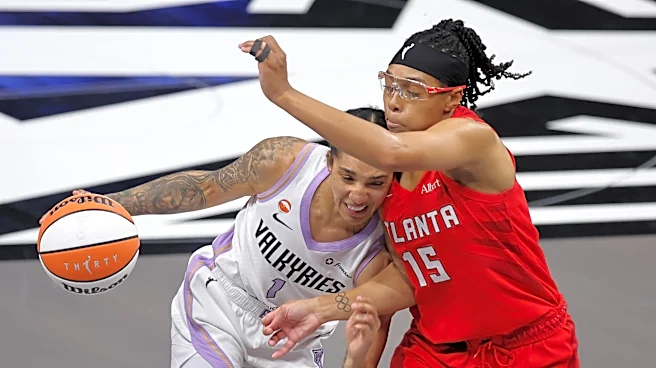
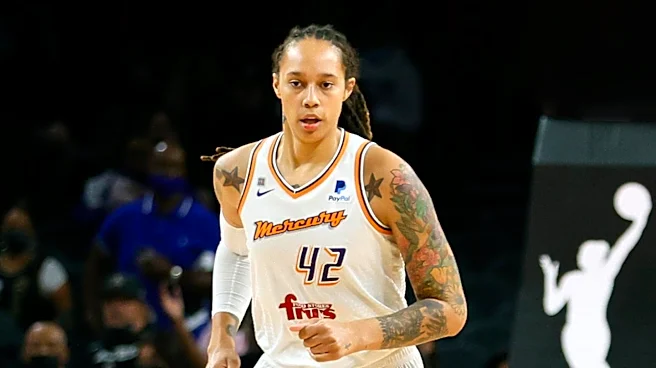
Sophie Cunningham, a former teammate of 10-time WNBA All-Star Brittney Griner on the Phoenix Mercury from 2019 to 2024, has publicly defended Griner's character. In a recent podcast appearance, Cunningham stated that Griner's public reputation is worse
than she deserves. Cunningham described Griner as "down to earth," "country," and "chill," emphasizing that she is "the coolest person you will ever meet." She recounted an incident at an airport where a security person, while trying to manage a crowd, accidentally hit Cunningham in the nose with one of Griner's Louis Vuitton bags, causing a black eye. Despite this, Cunningham's only criticism was directed at the security personnel, not Griner herself. The two players reportedly maintain a friendly relationship despite perceived political differences, as noted by activist Riley Gaines after observing their interaction at a game.
Why It's Important?
This defense of Brittney Griner's character by a close peer like Sophie Cunningham is significant in shaping public perception, especially given Griner's high-profile status and recent controversies. Griner's reputation has been subject to intense scrutiny, and a personal endorsement from a fellow athlete can humanize her image beyond media narratives. For the WNBA, this narrative helps to foster a sense of camaraderie among players, potentially mitigating the impact of external political or social divisions on team dynamics and player relationships. It also highlights the personal experiences of athletes, often overshadowed by their public personas, and underscores the importance of direct relationships in countering widespread public opinion. This could influence how fans and the media perceive not only Griner but also other athletes who face public judgment.
What's Next?
The comments from Sophie Cunningham may lead to a re-evaluation of Brittney Griner's public image among some fans and media outlets. While unlikely to completely alter deeply entrenched opinions, such personal testimonials can contribute to a more nuanced understanding of Griner's character. This could potentially influence future fan interactions, media coverage, and even endorsement opportunities for Griner. The ongoing friendly relationship between Cunningham and Griner, despite their differing political views, could also serve as an example of how personal connections can transcend broader societal divisions, potentially encouraging more respectful discourse within the sports community and beyond. Further discussions or interviews with other teammates or close associates could reinforce or challenge this portrayal.
Beyond the Headlines
The narrative surrounding Brittney Griner, as highlighted by Cunningham's defense, touches upon broader themes of public perception, media influence, and the humanization of public figures. In an era of rapid information dissemination and often polarized opinions, individuals, particularly those in the public eye, can be quickly defined by singular events or narratives. Cunningham's remarks underscore the disparity between a public persona and an individual's true character, suggesting that media portrayals often fail to capture the full complexity of a person. This situation also implicitly raises questions about the responsibility of media and the public in forming judgments, and how personal relationships can offer a counter-narrative to widespread assumptions. It reflects a cultural dynamic where celebrity status often comes with intense scrutiny, sometimes at the expense of personal truth.