





What's Happening?
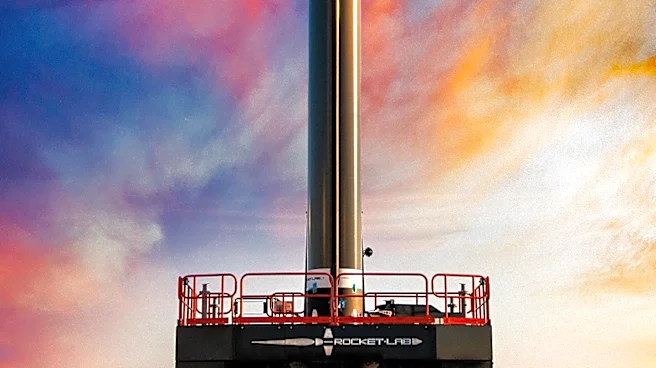
Rocket Lab successfully launched its 100th Electron rocket, 'The Mountain God Rises,' from New Zealand on November 14, placing the YAMATSUMI-II radar satellite into orbit. This milestone makes Electron the fastest commercially developed rocket to reach
100 launches. Despite this operational success and a record backlog of $3.57 billion across 117 launches, Rocket Lab's stock (RKLB) has declined by 11.8% year-to-date, trading near $61.53. The company's larger Neutron rocket, crucial for future revenue growth, has experienced further delays, with its first flight now pushed from late 2026 to sometime in 2027 due to issues found in the carbon-composite dome of its propellant tank. Neutron has 16 missions booked, valued at over $515 million, with its launch price increasing from $55 million to $70 million.
Why It's Important?
Rocket Lab's achievement of 100 Electron launches demonstrates its proven capability in the small satellite launch market, establishing a reliable track record that is critical for attracting and retaining customers. This operational consistency is a significant competitive advantage in the burgeoning space industry. However, the stock's underperformance despite this milestone highlights investor concerns regarding the delays of the Neutron rocket. Neutron is designed to carry heavier payloads, which is essential for Rocket Lab to compete in a broader segment of the launch market and achieve substantial revenue growth. The delays could impact the company's ability to capitalize on its backlog and meet market expectations, potentially affecting its valuation and long-term strategic positioning against competitors like SpaceX and Blue Origin.
What's Next?
Rocket Lab's immediate focus will be on resolving the technical issues with the Neutron rocket to ensure its first flight in 2027. The company has stated that the problem with the propellant tank dome has been fixed, but successful testing and a confirmed launch date will be crucial for investor confidence. Continued high-cadence launches of the Electron rocket will be important to maintain revenue and demonstrate operational efficiency. The company's ability to convert its substantial backlog into actual revenue, particularly with the Neutron, will be key to its financial performance and stock recovery. Analysts' average price target of $93.10 assumes significant revenue growth in 2027, heavily dependent on Neutron's successful debut.
Beyond the Headlines
The challenges faced by Rocket Lab, particularly with the Neutron rocket, reflect the inherent complexities and risks in developing advanced space launch technology. Delays are common in the aerospace industry, but they can have significant financial implications and impact market perception. This situation also underscores the intense competition in the space launch sector, where companies are vying for market share in both small and heavy-lift capabilities. Rocket Lab's strategy of building a strong foundation with Electron before transitioning to larger rockets is a common approach, but the transition period is critical. The success or failure of Neutron will not only determine Rocket Lab's future trajectory but also contribute to the broader narrative of commercial space exploration and the diversification of launch options beyond established players.