
What's Happening?
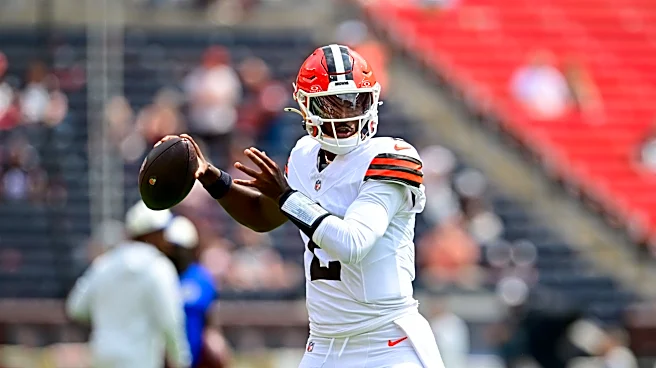
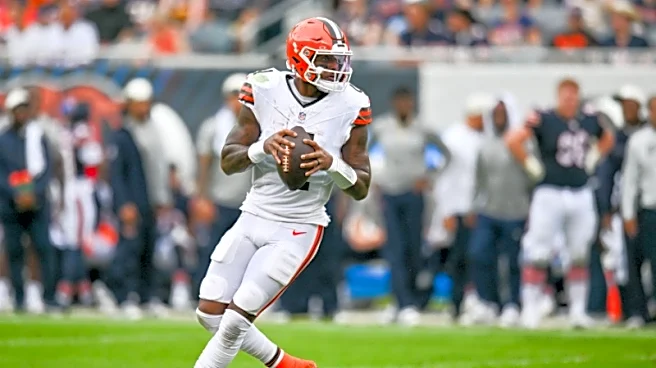
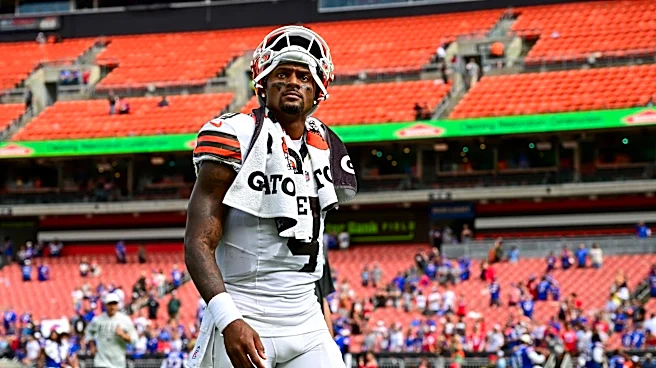
The Cleveland Browns are facing a complex financial decision regarding quarterback Deshaun Watson. While it is technically possible to cut Watson now, doing so would severely impact the team's 2027 season due to salary cap implications. According to reports,
if Watson were cut after June 1st, his 2026 cost to the team would remain at $27 million in salary cap space, with an estimated $20 million rolling over into the next year. However, Watson's current contract structure means he is set to remain on the roster until March 11, 2027, after which a post-June 1st cut would result in a $36,008,514 dead cap in 2027 and an additional $51,543,350 dead cap in 2028. Cutting him now would accelerate the 2028 dead cap into 2027, consuming a significant portion of the team's projected $49 million in cap space for that year, plus the $20 million rollover, leaving very little for other player acquisitions.
Why It's Important?
This situation highlights the intricate financial landscape of the National Football League (NFL) and the long-term consequences of large player contracts. For the Cleveland Browns, the decision regarding Deshaun Watson has profound implications for their competitive future. Cutting him prematurely would cripple their ability to sign new players, extend existing contracts, or acquire talent through free agency in 2027, effectively sacrificing a season. This financial constraint could deter potential free agents and make it challenging to build a competitive roster around a new quarterback, should they choose to draft one. The team's strategy of keeping Watson on the roster until March 2027, even if he is inactive or feigns injury, is a calculated move to mitigate the immediate financial damage and preserve future cap flexibility. This scenario underscores how salary cap management is as crucial as on-field performance in professional sports.
What's Next?
The Cleveland Browns are expected to keep Deshaun Watson on their roster until at least March 11, 2027, to avoid accelerating the significant dead cap charges into the 2027 season. This strategy would allow them to retain nearly $200 million in cash to spend in 2027 on draft picks, extensions, and free agents, enabling them to build a competitive team around a new quarterback, likely acquired through the draft. The team may explore options such as Watson feigning injury or being designated as a game-day inactive player to manage his presence on the roster without incurring immediate, severe financial penalties. The goal is to find a mutually acceptable solution that allows both parties to move on by the specified date without jeopardizing the team's financial health and future competitiveness.
Beyond the Headlines
This situation delves into the ethical and strategic complexities of player contracts in professional sports, particularly when a high-value player's performance or off-field issues do not align with expectations. The concept of a 'dead cap' illustrates how guaranteed money in contracts can bind teams to players even when their on-field utility diminishes. It also raises questions about player agency versus team control, as both parties navigate a contract that has become financially burdensome for the team. The Browns' approach of keeping Watson on the roster, even if inactive, highlights a pragmatic business decision to prioritize long-term financial stability over immediate, drastic action. This scenario could influence future contract negotiations across the NFL, potentially leading to more structured clauses or different approaches to guaranteed money to protect teams from similar predicaments.