


What's Happening?
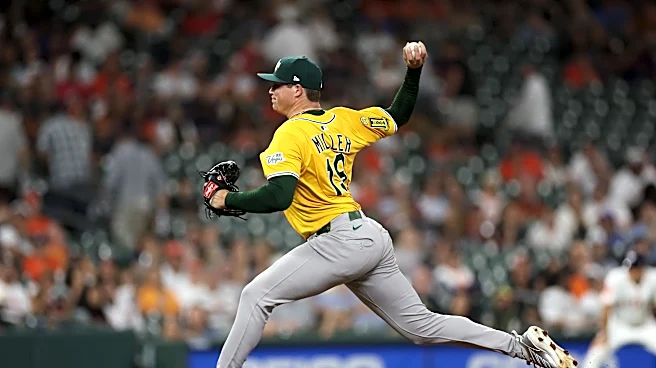
In 2026, six minor league pitchers within the Oakland Athletics organization reached velocities of 100 mph or higher, according to a list compiled by Baseball America. This places the Athletics tied for 12th among MLB franchises in terms of minor league pitchers achieving
this velocity milestone. The Pittsburgh Pirates led the league with 12 such pitchers. Notably, the Boston Red Sox and the Milwaukee Brewers, organizations from which the Athletics' new President of Baseball Operations Taylor Smith and GM Cam Castro respectively hail, had fewer minor league pitchers hit 100 mph, with five and three, though the Brewers had six big-league players reach this velocity. The six Athletics minor league pitchers who achieved this feat include Elvis Alvarado, Luis Morales, Abel Mercedes, Steven Echavarria, Michael Kelly, and Seth Johnson. Alvarado and Morales each appeared twice on the list, hitting 102.2 mph and 101 mph with their four-seamers, respectively. Some velocity readings, particularly for Alvarado and Kelly, showed a bump when pitching in Las Vegas.
Why It's Important?
The development of multiple minor league pitchers capable of throwing 100 mph is a significant indicator for the Oakland Athletics, a team that has historically faced challenges in pitching development. The hiring of Cam Castro as GM, partly due to his success in player development with the Milwaukee Brewers, suggests a strategic focus on improving the team's pitching staff. High-velocity pitchers are increasingly valuable in modern baseball, offering a competitive edge and contributing to strikeout rates. While raw velocity is not the sole determinant of success, it provides a strong foundation for future major league talent. This trend could signal a positive shift in the Athletics' player development pipeline, potentially leading to a more competitive pitching staff at the major league level in the coming years. The ability to cultivate such talent internally is crucial for a team like the Athletics, which often relies on player development due to budgetary constraints.
What's Next?
The Athletics' new front office, led by President of Baseball Operations Taylor Smith and GM Cam Castro, will likely continue to prioritize and refine their pitching development strategies. The focus will be on translating this raw velocity into effective major league performance. For pitchers like Abel Mercedes, who showed high velocity but struggled with walk rates, the next steps will involve targeted coaching to improve command and control. Steven Echavarria, despite his velocity, needs to address issues with unraveling when baserunners are on. The organization will need to assess how to best integrate these high-velocity arms into their system, whether through continued minor league development, strategic call-ups, or potential trade assets. The success of these pitchers in reaching the major leagues and performing consistently will be a key measure of the effectiveness of the Athletics' revamped development program.
Beyond the Headlines
The emphasis on high-velocity pitching in the Athletics' minor league system reflects a broader trend in professional baseball, where velocity is increasingly seen as a critical component for success. This shift is driven by advanced analytics and scouting, which highlight the effectiveness of high-speed fastballs in generating swings and misses. However, the challenge lies in combining velocity with control, movement, and pitch sequencing. The Athletics' situation, with several pitchers hitting 100 mph but some struggling with command, underscores this complexity. It raises questions about the balance between raw talent acquisition and comprehensive player development that addresses all aspects of pitching. The success of this approach will not only impact the Athletics' future competitiveness but also contribute to the ongoing evolution of pitching strategies across MLB, influencing how teams scout, draft, and develop their talent.