






What's Happening?
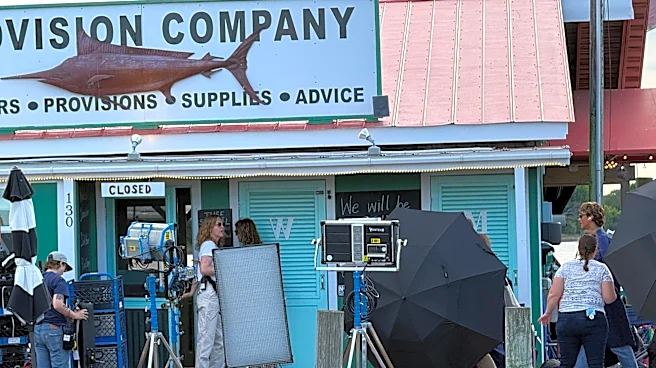
The Netflix series 'The Hunting Wives,' based on May Cobb’s 2021 novel, is expected to relocate its production from North Carolina for its potential third season. The show, starring Brittany Snow, Malin Akerman, and Dermot Mulroney, has been filmed in and around
Charlotte, North Carolina, for its first two seasons. However, changes to North Carolina's film incentive program have made it financially unfeasible for the production to continue in the state. Joan Cunningham, a producer for 'The Hunting Wives,' confirmed that the production will likely move to Georgia, a state known for its robust film tax credits. The second season of the series is scheduled to be released in November 2026, and while a third season has not been officially renewed by Netflix, actor Dermot Mulroney indicated in May that writers are already developing it.
Why It's Important?
This relocation highlights the significant impact of state film incentives on the entertainment industry and local economies. North Carolina's film industry, which supports thousands of jobs and brings millions in investment, is directly affected by these policy changes. The shift from a cash flow program, where funding could be secured based on future appropriations, to a more restrictive model, has made the state less competitive for large-scale productions. This situation can lead to job losses for local crews, reduced business for support services, and a decrease in tourism revenue associated with filming locations. For states like Georgia, which offer more stable and attractive incentives, such changes can result in an influx of productions, boosting their local economies and job markets. Governor Josh Stein of North Carolina acknowledged the importance of protecting the state's film industry and providing certainty for long-term investment.
What's Next?
While Netflix has not yet officially announced a third season renewal for 'The Hunting Wives,' the production team is preparing for a move to Georgia if it proceeds. This move would mean that iconic North Carolina locations, such as the Azalea Retreat on Lake Norman and Downtown Mooresville, which have served as backdrops for the fictional town of Maple Brook, Texas, will no longer be featured. The situation also puts pressure on North Carolina lawmakers to re-evaluate their film incentive policies to remain competitive in attracting and retaining film and television productions. Other network shows, including 'Outer Banks,' 'Homeland,' and 'Banshee,' have previously left North Carolina due to fluctuating state film incentives, indicating a recurring challenge for the state's film industry.
Beyond the Headlines
The departure of 'The Hunting Wives' from North Carolina underscores a broader trend in the film and television industry where production locations are heavily influenced by financial incentives. This practice, while beneficial for states offering attractive tax credits, can create a volatile environment for local film industries in states with less stable programs. It raises questions about the long-term sustainability of relying on such incentives and the potential for a 'race to the bottom' among states competing for productions. Furthermore, it highlights the cultural impact of losing productions that showcase local landmarks and contribute to a state's identity on screen. The decision to move also reflects the complex interplay between state economic policy, the entertainment industry's financial models, and the livelihoods of thousands of individuals working in film and television production.