





What's Happening?
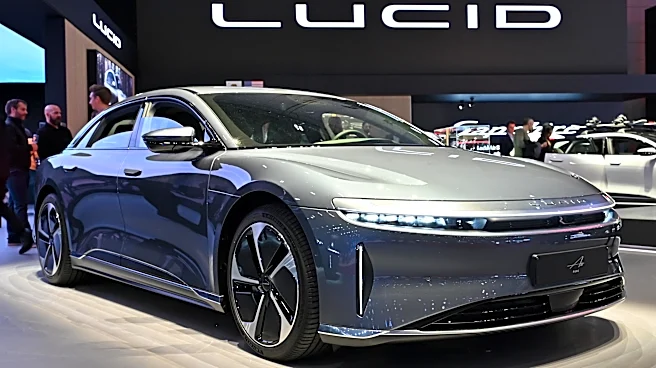
Lucid Group missed Wall Street's third-quarter earnings expectations as it continues an 'operational reset' aimed at reducing costs and narrowing losses. The electric vehicle maker reported a loss per share of $2.74 against an expected loss of $2.28,
and revenue of $350 million compared to an anticipated $407 million. Despite these misses, the company's adjusted earnings before interest, taxes, depreciation, and amortization (EBITDA) showed a loss of $726 million, which was better than the expected loss of $611 million. The net loss for the quarter was $830.9 million, an improvement from $978.4 million a year earlier. In a significant development, Lucid announced a $1.75 billion increase in a delayed draw term loan from Saudi Arabia's Public Investment Fund (PIF), its largest shareholder. This additional funding boosts Lucid's total liquidity to $3.75 billion, up from $2 billion at the end of the third quarter. Lucid stock fell approximately 5% in aftermarket trading.
Why It's Important?
Lucid Group's third-quarter results underscore the financial pressures and operational challenges facing electric vehicle startups. The significant earnings and revenue misses highlight the difficulty in scaling production and achieving profitability in a highly competitive market. However, the better-than-expected adjusted EBITDA loss suggests that the company's cost-cutting efforts, initiated under CEO Silvio Napoli, are beginning to show some positive impact. The $1.75 billion loan from Saudi Arabia's PIF is a critical lifeline, providing essential financial flexibility to support Lucid's turnaround program and fund key investments, including the delayed midsize vehicle. This continued support from its anchor shareholder is vital for Lucid to sustain operations and pursue its long-term growth strategy. Without such substantial backing, the company's ability to navigate its current financial headwinds would be severely constrained, impacting its market position and future product development.
What's Next?
Lucid Group plans to communicate its midterm plan and targets early next year, following the suspension of its guidance in May. This upcoming plan will outline the company's strategy for achieving profitable long-term growth, including further details on cost-cutting efforts and the timeline for its midsize vehicle, which has been delayed from the end of this year to the second half of next year. The additional capital from the PIF is expected to provide financial stability through the fourth quarter of 2027, supporting operations and the launch of the midsize vehicle. CEO Silvio Napoli emphasized the company's focus on execution and commitments to build a stronger, sustainable Lucid. The company's turnaround plan also includes efforts to improve cash flow by $1.4 billion this year and explore opportunities like a robotaxi program with Uber and Nuro, and the ongoing construction of a factory in Saudi Arabia.
Beyond the Headlines
The ongoing financial support from Saudi Arabia's Public Investment Fund for Lucid Group highlights the strategic investments being made by sovereign wealth funds in emerging technologies and industries. This partnership extends beyond mere financial backing, as evidenced by the construction of a Lucid factory in Saudi Arabia, indicating a deeper collaboration and a potential role for Lucid in the Kingdom's economic diversification efforts. The delay of Lucid's midsize vehicle, a crucial product for expanding its market reach, reflects the inherent complexities and capital intensity of developing and launching new EV models. This situation is not unique to Lucid, as many EV startups face similar challenges in balancing innovation with financial sustainability. The success of Lucid's 'operational reset' and its ability to leverage the PIF's investment will be a significant indicator of the viability of new entrants in the global EV market.