


What's Happening?
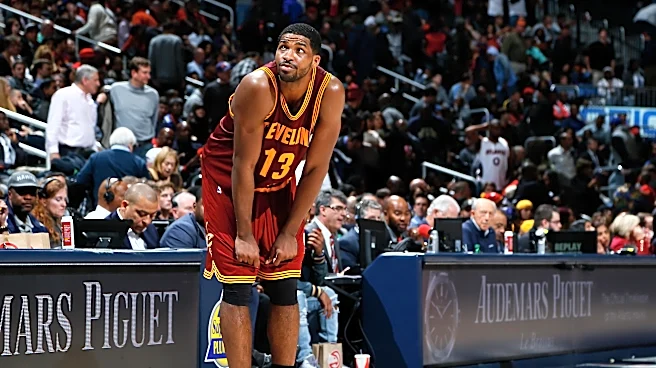
Tristan Thompson's significant contribution to the Cleveland Cavaliers' 2016 NBA Finals win against the Golden State Warriors is being recognized, particularly his offensive rebounding. In that series, Thompson secured 27 total offensive rebounds, a crucial
factor in the Cavaliers' ability to overcome a 3-1 deficit. This figure surpassed LeBron James's 17 offensive rebounds and Andre Iguodala's 16 for the Warriors. The article emphasizes that while LeBron James and Kyrie Irving made key plays, Thompson's rebounding provided critical second-chance opportunities, which translated into additional points for the Cavaliers. The Cavaliers finished the series with 309 total rebounds compared to the Warriors' 279, with 10 more offensive rebounds directly contributing to their success. This performance underscores the enduring importance of a strong 'big man' in the NBA, even in an era increasingly dominated by guard play and three-point shooting.
Why It's Important?
Thompson's performance in the 2016 NBA Finals highlights the strategic value of offensive rebounding in high-stakes basketball, demonstrating how a single player's specialized skill can significantly influence game outcomes. In a league that has increasingly prioritized three-point shooting and guard-oriented offenses, Thompson's impact serves as a reminder that traditional 'big man' roles, particularly in rebounding and defense, remain vital for championship contention. His ability to create extra possessions for the Cavaliers directly contributed to their historic comeback, illustrating that a balanced team approach, incorporating both perimeter scoring and interior dominance, is often key to success. This also influences team building strategies, as franchises must weigh the benefits of versatile, shooting-oriented big men against those who excel in traditional rebounding and defensive roles.
What's Next?
The trend in the NBA continues towards versatile 'big men' who can stretch the floor and shoot from beyond the arc, as exemplified by players like Kristaps Porzingis and Karl-Anthony Towns. However, the success of players like Thompson in specific, traditional roles suggests that teams will continue to seek a balance. While the league evolves with more position-less play, the fundamental importance of rebounding and interior presence, as demonstrated by Thompson, will likely remain a critical component of championship-winning formulas. Future team compositions may increasingly feature 'stretch-bigs' to open up the floor, but the lesson from the 2016 Finals indicates that a dedicated rebounder can still be an invaluable asset, especially in close, high-pressure series.
Beyond the Headlines
Thompson's 2016 Finals performance challenges the prevailing narrative that the NBA has entirely moved away from the traditional 'big man' role. While the game has undoubtedly evolved to favor athleticism, three-point shooting, and versatility, his impact underscores that certain fundamental aspects of basketball, such as offensive rebounding, retain their critical importance. This suggests a deeper strategic consideration for coaches and general managers: how to integrate traditional strengths within a modern, fast-paced, and perimeter-oriented game. It highlights that while the archetype of the 'big man' has changed, the need for players who can control the paint and secure extra possessions remains a timeless element of winning basketball, influencing how teams are constructed and how games are strategized at the highest levels.