









What's Happening?
The mythological figure of Medusa, one of the three Gorgon sisters, is being re-examined through various accounts, highlighting her complex origins and transformation. Initially, Medusa was depicted as a mortal Gorgon with snaky hair and a petrifying
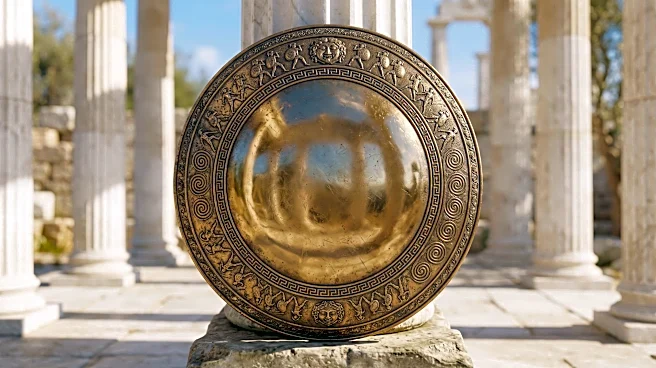
gaze, born to primordial sea gods. A more widely known version, detailed by the Roman poet Ovid, portrays her as a beautiful priestess of Athena whose hair was transformed into snakes and her face cursed to turn onlookers to stone after Poseidon forced himself upon her in Athena's temple. This act of desecration led Athena to punish Medusa, not Poseidon. The hero Perseus, aided by Athena and Hermes, ultimately severed Medusa's head, using a polished bronze shield to avoid her direct gaze. From her spilled blood, the winged horse Pegasus and the warrior Chrysaor were born. Perseus later used Medusa's head as a weapon, turning the sea monster Cetus and the tyrant Polydectes to stone, before gifting it to Athena to adorn her shield, the Aegis.
Why It's Important?
Medusa's narrative holds significant cultural importance, evolving from a monstrous figure to a symbol of female strength and resistance. Her image, known as the Gorgoneion, was widely used in ancient times as a protective emblem on shields, armor, and city gates, believed to ward off evil. This enduring symbolism demonstrates how ancient myths can continue to influence and reflect societal values across millennia. The reinterpretation of Medusa's story in modern times, viewing her as a victim rather than solely a monster, highlights a shift in perspective towards understanding the complexities of power, punishment, and gender in historical narratives. This evolution underscores the dynamic nature of mythology and its capacity to adapt to contemporary social discourse, offering new insights into ancient tales and their relevance today.
What's Next?
The ongoing re-evaluation of Medusa's myth suggests a continued exploration of her character in various forms of media and academic discourse. Modern interpretations are likely to further emphasize her role as a symbol of female empowerment and resilience, moving beyond the traditional monstrous depiction. This could lead to new artistic representations, literary analyses, and educational discussions that delve into the ethical and social implications of her story. The enduring fascination with Medusa indicates that her narrative will remain a fertile ground for examining themes of justice, victimhood, and the transformation of identity, ensuring her continued presence in cultural consciousness and potentially inspiring new works that challenge conventional understandings of ancient myths.
Beyond the Headlines
The transformation of Medusa's image from a terrifying monster to a symbol of female rage and resistance reveals deeper cultural shifts in how narratives of victimhood and power are understood. Her story, particularly Ovid's version, raises ethical questions about divine justice and the disproportionate punishment of victims. The act of Athena punishing Medusa for a crime committed against her in the goddess's own temple highlights a complex interplay of power dynamics and accountability. This recontextualization allows for a critical examination of historical narratives that often demonize female figures, offering a lens through which to analyze broader societal patterns of blaming victims. Medusa's enduring presence in popular culture, from ancient protective symbols to modern feminist interpretations, underscores the timeless human need to grapple with themes of beauty, monstrosity, and the quest for justice.