





What's Happening?
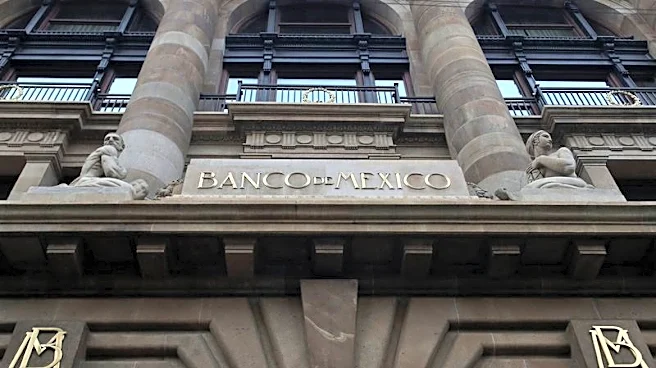
Mexico's central bank, Banxico, lowered its benchmark interest rate by 25 basis points to 6.25% at its November 2026 meeting. This decision defied market expectations, which had largely anticipated the bank would hold rates steady. The Governing Board
cited continued disinflation, prevailing economic slack, and a limited pass-through of exchange rate movements to consumer prices as reasons for the cut. Banxico also noted the absence of demand-side inflationary pressures and affirmed that the existing monetary restriction remained in place. While headline inflation forecasts were revised upward for Q4 2026 and core inflation projections were slightly adjusted higher, the central bank still expects headline inflation to converge to its 3% target by Q4 2027. The board indicated that maintaining rates at this new level for an extended period would support inflation convergence and help address external macroeconomic challenges.
Why It's Important?
This unexpected rate cut by Banxico signals a shift in monetary policy, potentially indicating the central bank's confidence in controlling inflation while supporting economic activity. For businesses in Mexico, lower interest rates can reduce borrowing costs, potentially stimulating investment and expansion. This could lead to increased economic growth and job creation. For consumers, it might translate to lower costs for loans and mortgages, boosting spending power. However, the upward revision of inflation forecasts for the near term suggests that while the bank is acting to stimulate the economy, it remains vigilant about price stability. The decision could also influence foreign investment, as lower rates might make Mexican assets less attractive to investors seeking higher yields, potentially impacting the peso's value. The market's surprise reaction indicates that this move was not fully priced in, which could lead to short-term volatility in financial markets.
What's Next?
Banxico's Governing Board has indicated that keeping interest rates at the newly established level for an extended period will be crucial for supporting inflation convergence towards its target and addressing external macroeconomic challenges. This suggests that further immediate rate cuts may not be on the horizon, as the bank aims to observe the impact of this reduction. Market participants will closely monitor upcoming inflation data and economic indicators to gauge the effectiveness of this policy move and anticipate future actions. Any significant deviation from the projected inflation trajectory or unexpected economic shifts could prompt Banxico to reconsider its stance. Additionally, the central bank's communication regarding its assessment of external macroeconomic conditions will be key in understanding its future monetary policy direction. Businesses and consumers will likely adjust their financial planning based on the expectation of sustained lower borrowing costs for the foreseeable future.
Beyond the Headlines
The unexpected nature of Banxico's rate cut could reflect a more proactive approach by the central bank to manage economic conditions, potentially signaling a greater willingness to deviate from market consensus when its internal assessments warrant such action. This could enhance the bank's independence and credibility in the long run, demonstrating its commitment to its mandate based on its own analysis. However, it also introduces an element of unpredictability for market participants, who may need to adjust their forecasting models to account for more independent decision-making. The emphasis on 'prevailing economic slack' and 'absence of demand-side inflationary pressures' suggests that Banxico might be prioritizing growth support in an environment where it perceives inflation risks as manageable. This could set a precedent for how the bank balances its dual mandate of price stability and economic growth in future policy decisions, particularly if global economic conditions remain uncertain.