




What's Happening?
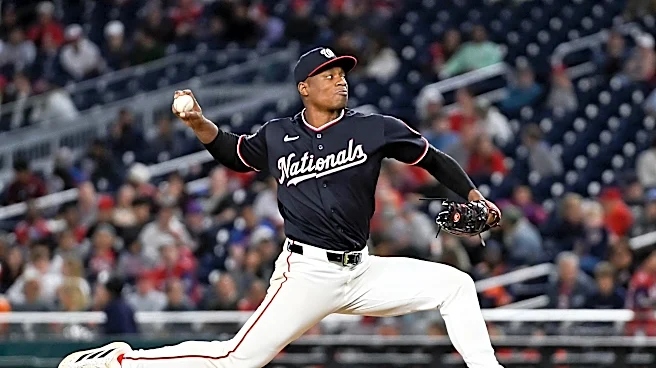
The Texas Rangers are reportedly considering trading left-handed pitcher MacKenzie Gore, who was acquired from the Washington Nationals in January 2026 in exchange for five prospects. Gore completed his first season with the Rangers, posting an 8-11 record
with a 4.58 ERA over 34 starts, leading the majors in starts. He also recorded 174 strikeouts in 173 innings with a 1.34 WHIP. Former New York Mets general manager Steve Phillips noted on MLB Network that the Rangers are listening to offers for Gore, who is entering his final year of arbitration. Gore signed a one-year deal for $5.6 million in 2026 to avoid arbitration with Washington before the trade. He is projected to earn around $8.7 million to $11.4 million in his final arbitration year for 2027, according to different projections.
Why It's Important?
This potential trade is significant for the Texas Rangers as they aim to shed payroll and improve their roster. The high price paid for Gore—five prospects, including a 2025 first-round pick—makes any decision to trade him complex. However, with Gore's projected arbitration salary for 2027, moving him could free up significant funds. This financial flexibility is crucial for the Rangers, especially given that key veterans like Corey Seager, Jacob deGrom, and Nathan Eovaldi have no-trade clauses, limiting other avenues for payroll reduction. The situation highlights the strategic challenges MLB teams face in balancing player acquisition costs, performance, and financial management, particularly with players nearing free agency. For interested teams, acquiring Gore would mean a single season commitment before he becomes a free agent after the 2027 season.
What's Next?
The immediate next step for the Texas Rangers is to evaluate potential trade offers for MacKenzie Gore. The deadline for clubs to tender contracts to arbitration-eligible players is Friday, November 20. This deadline will likely influence the urgency of any trade discussions. If the Rangers do not trade Gore, they will need to tender him a contract for his final arbitration year, committing to his projected salary. The collective bargaining agreement between MLB and the players' union is also set to expire on December 1, which could introduce further considerations for player contracts and trades. The Rangers will need to weigh the value of retaining Gore for one more season against the prospects or financial relief they could gain from a trade.
Beyond the Headlines
The MacKenzie Gore situation underscores a broader trend in MLB where teams are increasingly strategic about managing player contracts, especially those approaching free agency. The 'complicated trade' scenario, as described by Steve Phillips, reflects the intricate balance between a player's performance, their remaining contract years, and the team's financial health. For players like Gore, who was an All-Star in 2025, a trade could offer a fresh start and a chance to prove his long-term value before hitting the free-agent market. For teams, these decisions are not just about immediate roster needs but also about long-term financial sustainability and competitive strategy, particularly when faced with expensive veteran contracts that include no-trade clauses. The outcome of this situation could set a precedent for how teams handle high-value, arbitration-eligible players with significant acquisition costs.