





What's Happening?
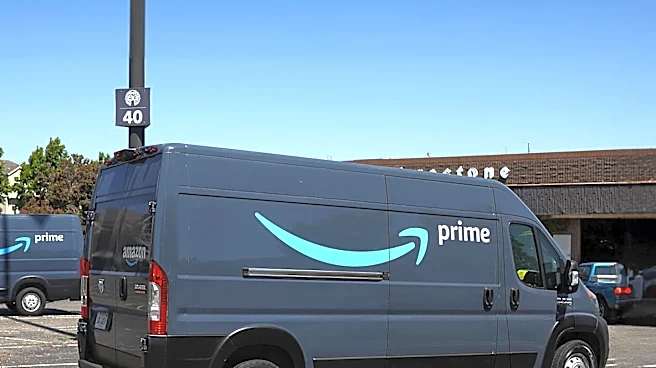
Amazon.com is actively opposing New York City's proposed Delivery Protection Act, arguing that the new regulations could lead to increased operational costs and slower service delivery within the city. The company has communicated to city officials that these
rules might render its last-mile delivery network in NYC economically unviable or force it to withdraw from certain delivery routes. Concurrently, Blue Owl Capital is facilitating over $500 million in structured financing for an Amazon-leased data center. These two developments collectively highlight the evolving risk profile of Amazon, particularly concerning its logistics operations and its substantial investments in AI infrastructure. The company's strategy involves leveraging partners for large, AI-ready real estate while securing long-term usage through leases and service contracts, which also contributes to its off-balance-sheet obligations.
Why It's Important?
Amazon's opposition to the NYC Delivery Protection Act is significant because it challenges the underlying assumption that logistics optimization can consistently offset the increasing complexity of retail operations. If new employment rules make certain delivery routes unprofitable, it could undermine Amazon's ability to maintain its promise of shipping and fulfillment costs growing slower than unit volumes, potentially impacting its competitive edge against rivals like Walmart or Target. The financing deal with Blue Owl Capital for a data center underscores Amazon's massive capital expenditure program focused on AI, data centers, servers, and satellite infrastructure. The success of this strategy hinges on converting these investments into long-duration contracts that generate strong free cash flow and attractive returns on invested capital. However, the reliance on off-balance-sheet obligations, which regulators have previously identified as a risk, adds another layer of scrutiny to Amazon's financial health and operational model.
What's Next?
The outcome of Amazon's dispute with New York City over the Delivery Protection Act will be crucial for its urban logistics strategy. If the rules are implemented as proposed, Amazon may need to re-evaluate its delivery network in NYC, potentially leading to service adjustments or increased costs for consumers. This could also set a precedent for similar regulations in other major U.S. cities, impacting the broader e-commerce logistics landscape. On the infrastructure front, Amazon will likely continue to pursue partnerships and structured financing arrangements for its AI-ready real estate, aiming to secure long-term usage while managing its balance sheet. The company's ability to lock in these heavy AI and logistics spending into long-duration contracts will be a key determinant of its future profitability and investor confidence. Regulators will also likely continue to monitor the growth of off-balance-sheet obligations across the industry.
Beyond the Headlines
These developments highlight a broader tension between technological advancement, urban policy, and corporate financial strategies. Amazon's pushback against NYC delivery rules reflects the ongoing debate about the gig economy, worker protections, and the cost of doing business in densely populated areas. The company's extensive investment in AI infrastructure, financed through complex structures, points to the increasing capital intensity of the digital economy and the innovative ways companies are funding their growth. This also raises questions about the transparency and potential systemic risks associated with growing off-balance-sheet liabilities. The interplay between regulatory environments, technological innovation, and financial engineering will continue to shape the future of e-commerce and cloud computing, influencing everything from consumer prices to labor markets and financial stability.