
What's Happening?
Grayscale Investments, a digital asset manager, has shifted its focus from chip manufacturers to the electrical grid as the primary constraint for artificial intelligence (AI) growth. In a September research
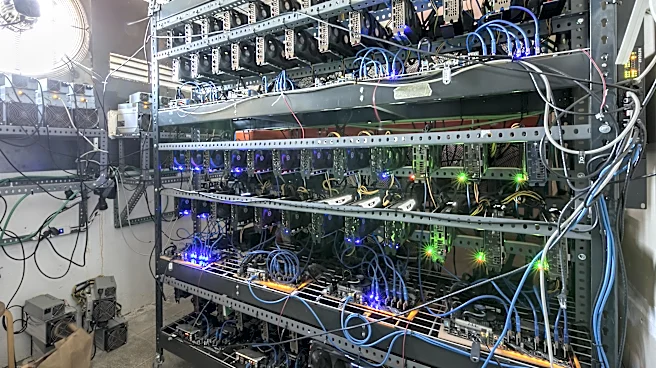
report, Grayscale argued that companies best positioned to profit from the AI boom are those that already possess the necessary power connections and physical space: Bitcoin miners. The firm identified 11 U.S.-listed companies at this intersection, with nine being current or former Bitcoin miners. Four of these companies, including Cipher Mining, Core Scientific, Applied Digital, and Galaxy Digital, have already fully transitioned their businesses to AI and high-performance computing (HPC). Grayscale estimates that AI and HPC workloads generate approximately double the revenue per megawatt-hour compared to Bitcoin mining, making the pivot attractive for operators with long-dated interconnection agreements.
Why It's Important?
This analysis by Grayscale highlights a significant strategic opportunity for Bitcoin mining companies, positioning them as crucial infrastructure providers for the rapidly expanding AI industry. The report underscores that securing grid connections can take over five years, and lead times for transformers can exceed three years, making existing powered data centers a scarce and valuable resource. This perspective could drive further investment into companies with established power infrastructure, potentially leading to a revaluation of their assets beyond their traditional Bitcoin mining operations. For the broader U.S. economy, this trend could accelerate the development of AI capabilities by repurposing existing energy-intensive infrastructure, thereby mitigating some of the bottlenecks in AI deployment. It also suggests a potential shift in the investment landscape, with more capital flowing into companies that can provide the foundational power and space for AI workloads.
What's Next?
The insights from Grayscale's report are likely to encourage more Bitcoin mining companies to explore or accelerate their transition into AI and HPC data center operations. Investors will be closely watching the performance of the 11 flagged companies, particularly those that have already made the pivot, to gauge the success of this business model transformation. The demand for power and data center space for AI is expected to continue its rapid growth, which could lead to increased competition for existing infrastructure and further consolidation within the sector. Companies with long-term power agreements and strategic locations will likely become prime targets for partnerships or acquisitions by larger tech firms seeking to expand their AI capabilities. This trend could also spur innovation in energy efficiency and sustainable power solutions within data centers as the energy demands of AI continue to escalate.
Beyond the Headlines
The re-evaluation of Bitcoin mining infrastructure as a critical asset for AI development signifies a broader economic and technological convergence. It challenges the traditional perception of Bitcoin mining as a standalone, energy-intensive activity and instead positions it as a foundational component for future technological advancements. This shift could have profound implications for energy policy, grid management, and regional economic development, particularly in areas where large-scale mining operations are already established. Furthermore, it raises ethical considerations regarding the optimal use of energy resources and the environmental impact of both cryptocurrency mining and AI. The ability to repurpose existing infrastructure for AI could also foster new business models and partnerships between energy providers, data center operators, and AI developers, creating a more integrated and efficient digital economy.