


What's Happening?
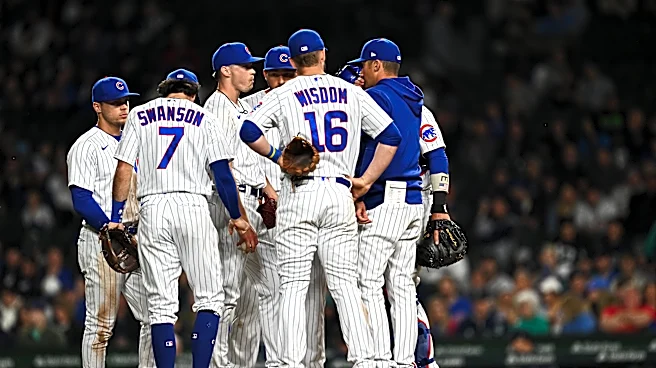
The Chicago Cubs are reportedly not planning to be major bidders for two-time American League Cy Young Award winner Tarik Skubal, despite having a significant need for rotation help. According to Sahadev Sharma of The Athletic, the Cubs will likely check
in but are not expected to pursue Skubal aggressively. This decision aligns with the Ricketts family ownership group's historical caution regarding large pitching contracts; the team's largest contract for a pitcher, Jon Lester's $155MM deal, dates back to the 2014-15 offseason. Skubal is projected to command a contract well exceeding $325MM, which is outside the Cubs' typical comfort zone. The team's strategy appears to be a volume-based approach, seeking to diversify their investment across several arms rather than committing a substantial amount to one premier starter. This is partly due to a wide-ranging need for pitching, with several current pitchers either injured or entering free agency.
Why It's Important?
This strategic decision by the Cubs has significant implications for the MLB free agent market and the team's competitive future. By opting out of the bidding for a top-tier pitcher like Skubal, the Cubs are signaling a continued adherence to a more conservative spending philosophy, which could impact their ability to contend for championships in the short term. This approach also suggests that the team prioritizes depth and flexibility over acquiring a single superstar, potentially spreading their payroll across multiple mid-tier free agents or utilizing their young infielders as trade assets for controllable, pre-arbitration arms. For other MLB teams, the Cubs' stance could reduce competition for Skubal, potentially influencing his final contract value and destination. The focus on grounder- and strikeout-heavy pitchers also indicates a strategic alignment with their dominant infield defense, aiming to maximize their existing roster strengths.
What's Next?
The Cubs are expected to pursue a volume-based approach to address their rotation needs, focusing on acquiring multiple pitchers rather than one high-priced ace. Names like Michael King and Adrian Morejon are mentioned as potential targets, though their pricing could still exceed the team's comfort level. The team will likely explore both free agency and the trade market, with young infielders Matt Shaw and Pedro Ramirez frequently speculated as trade candidates. The Cubs have considerable payroll flexibility, with projected payroll for next year still well below their 2026 actual cash payroll. Their strategy will involve identifying pitchers who can maximize their strong infield defense by inducing ground balls and strikeouts. The upcoming offseason will reveal how effectively the Cubs can execute this strategy and whether their conservative approach to pitching contracts will yield a competitive rotation for the 2027 season.
Beyond the Headlines
The Cubs' decision reflects a broader trend in MLB where teams balance the pursuit of elite talent with financial prudence and long-term roster construction. While a superstar signing can generate immediate fan excitement, the Cubs' strategy suggests a focus on sustainable competitiveness through depth and strategic player acquisition. This approach can be seen as a response to the volatility of pitching performance and the high costs associated with long-term contracts for pitchers. It also highlights the increasing importance of analytics in player evaluation, as the team seeks pitchers whose skill sets align with their defensive strengths. The success or failure of this strategy could influence how other mid-market or financially cautious teams approach future free agency periods, potentially shifting the dynamics of player valuation and team building across the league.