





What's Happening?
CATL has introduced its new 30# Chocolate Battery, a 100 kWh swappable battery designed to significantly enhance the driving range of electric vehicles (EVs). This new battery is capable of providing approximately 700 km (435 miles) of range on China’s
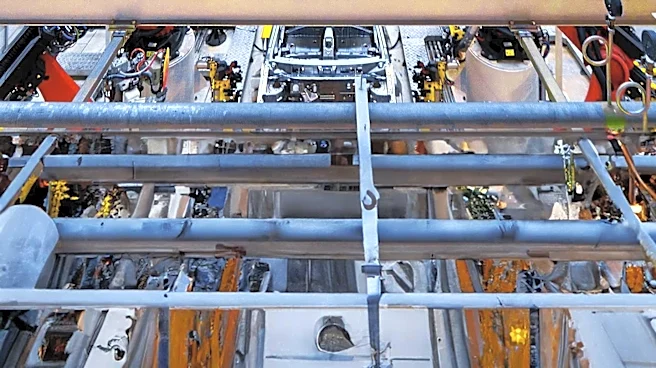
CLTC test cycle, expanding CATL's existing portfolio of standardized battery-swapping options. The 30# Chocolate Battery delivers a peak discharge power of 600 kW, enabling EVs to accelerate from 0 to 100 km/h in roughly three seconds. A key feature of this innovation is its rapid exchange capability, allowing the battery to be swapped at a dedicated station in just 99 seconds, presenting a swift alternative to traditional charging methods. Furthermore, the battery can gain about 400 km of driving range with only 10 minutes of fast charging, according to CarNewsChina. Its robust locking mechanism is engineered to endure daily battery swaps, projecting a theoretical lifespan of 27 years, and CATL provides a lifetime warranty for batteries within its swapping network.
Why It's Important?
This development from CATL holds significant implications for the electric vehicle market, particularly in addressing common consumer concerns regarding range anxiety and charging times. By offering a 100 kWh swappable battery with a substantial 435-mile range and a 99-second exchange time, CATL is presenting a compelling alternative to conventional EV charging infrastructure. This technology could accelerate EV adoption by making the ownership experience more convenient and comparable to refueling gasoline-powered vehicles. The extended theoretical lifespan of 27 years and the lifetime warranty offered by CATL could also reduce long-term ownership costs and enhance consumer confidence in EV battery durability. For the U.S. market, while the CLTC test cycle is specific to China, the underlying technology could influence future battery development and infrastructure strategies, potentially leading to similar swappable battery solutions or inspiring advancements in fast-charging technologies to compete with such rapid exchange systems. This innovation could also spur competition among battery manufacturers and EV makers to develop more efficient and user-friendly energy solutions.
What's Next?
The introduction of CATL's 30# Chocolate Battery is expected to further drive the expansion of battery-swapping infrastructure, particularly in regions where CATL operates or has partnerships. The success of this technology could encourage other battery manufacturers and automotive companies to invest more heavily in swappable battery solutions, potentially leading to standardized battery designs across different EV models. This could create a new ecosystem for EV energy management, where battery ownership might be separated from vehicle ownership, offering more flexible subscription models for consumers. Additionally, the rapid charging capabilities of the battery, adding 400 km of range in 10 minutes, could push the boundaries of fast-charging technology, prompting further research and development in this area. The long theoretical lifespan and lifetime warranty could also set new industry standards for battery durability and customer assurance, influencing consumer expectations and regulatory frameworks for EV batteries globally.
Beyond the Headlines
The unveiling of CATL's 100 kWh swappable battery transcends mere technological advancement; it represents a potential paradigm shift in the electric vehicle industry's approach to energy delivery and consumption. The concept of battery swapping, while not new, gains significant traction with such high-capacity, long-range, and rapidly exchangeable units. This could lead to a 'battery-as-a-service' model becoming more prevalent, where consumers lease batteries rather than owning them, thereby reducing the upfront cost of EVs and mitigating concerns about battery degradation and replacement. Such a model could also facilitate easier upgrades to newer battery technologies as they emerge. Furthermore, the emphasis on a 27-year theoretical lifespan and a lifetime warranty highlights a growing focus on sustainability and circular economy principles within the EV battery sector, potentially reducing waste and promoting responsible resource management. This innovation could also influence urban planning and infrastructure development, as dedicated battery-swapping stations might become a common feature alongside traditional charging points, reshaping the landscape of EV refueling.