





What's Happening?
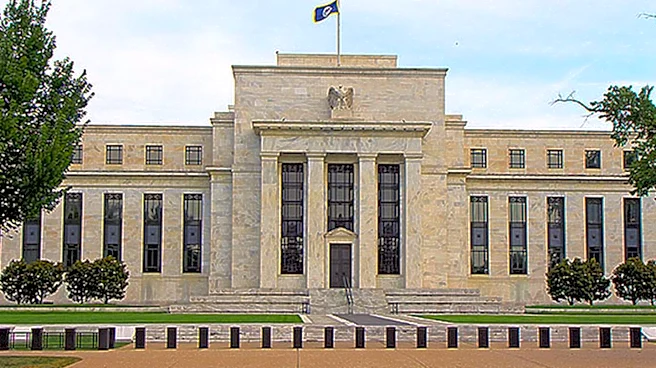
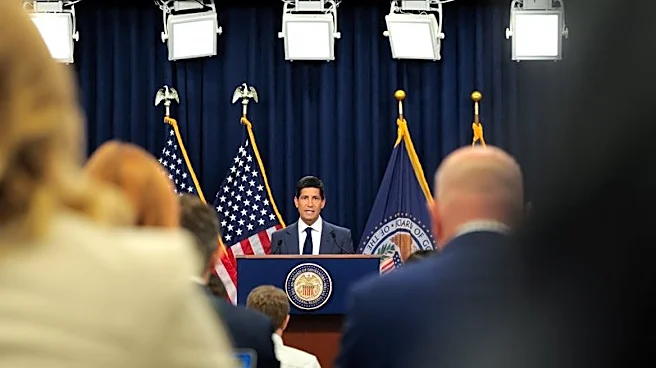
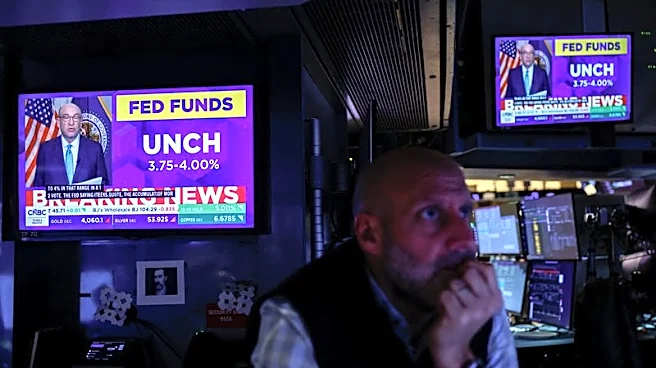
The Federal Reserve has decided to keep its benchmark interest rate steady, maintaining the federal funds rate target range at 3.75% to 4%. This decision, made by the Federal Open Market Committee with a 10-2 vote, follows a quarter-percentage-point increase
in September. The pause allows policymakers more time to evaluate inflation and broader economic conditions. Despite the hold, the Fed's statement indicated that economic growth remains strong, citing resilient domestic spending, robust capital investment, and consistent job gains. Inflation, however, continues to be elevated, and geopolitical developments contribute to ongoing uncertainty. The two dissenting votes, from Lisa Cook and Beth Hammack, favored an immediate quarter-percentage-point increase, highlighting an internal debate within the committee regarding the necessity of further tightening to achieve the central bank's 2% inflation target. The Fed's next policy meeting is scheduled for December 8-9, where updated economic projections will be released.
Why It's Important?
This decision by the Federal Reserve provides a period of stability for businesses and consumers regarding borrowing costs, rather than an immediate reduction. For U.S. businesses, particularly those in Kentucky preparing their 2027 budgets, the key concern is how long financing costs will remain elevated. Companies utilizing variable-rate credit lines or planning to refinance debt are particularly sensitive to future rate decisions. Similarly, consumers considering major purchases like mortgages or vehicles face uncertainty, as their loan rates are influenced by, but do not directly mirror, the federal funds rate. The Fed's cautious approach reflects a balancing act: aiming to curb inflation without triggering a significant economic slowdown. Investors will closely monitor whether inflation moderates organically, reducing the need for further rate hikes, or if persistent price pressures will necessitate additional tightening measures, impacting market stability and economic growth prospects.
What's Next?
The Federal Reserve's next policy meeting on December 8-9 will be crucial, as it will include updated economic projections and a potential decision on further interest rate adjustments. Minutes from the September meeting indicated that most participants believed another rate increase would likely be appropriate by year-end, suggesting that a December hike remains a strong possibility. However, future decisions are explicitly tied to incoming economic data and its implications for inflation and the broader economy. The current pause allows the Fed to gather more evidence before committing to another move. Stakeholders, including financial markets, businesses, and consumers, will be closely watching economic indicators such as inflation reports, employment figures, and consumer spending data in the coming weeks. Any significant shifts in these metrics could influence the Fed's stance, potentially leading to either a rate hike or a continued pause, impacting borrowing costs and investment decisions across the U.S. economy.
Beyond the Headlines
The Federal Reserve's ongoing debate over interest rates reflects a deeper challenge in monetary policy: navigating an economy with strong growth but persistent inflation. The two dissenting votes for an immediate rate hike underscore differing views on the urgency and efficacy of further tightening. This internal division highlights the complexity of achieving a 'soft landing' – bringing inflation down without triggering a recession. The Fed's communication strategy will be critical in managing market expectations and preventing undue volatility. Furthermore, the impact of geopolitical developments, explicitly mentioned by the Fed, adds another layer of uncertainty, as global events can influence energy prices, supply chains, and overall economic stability. The long-term implications involve the potential for prolonged higher borrowing costs, which could reshape investment patterns, consumer behavior, and the overall growth trajectory of the U.S. economy, particularly for sectors reliant on accessible credit.