





What's Happening?
Zipline, an autonomous drone delivery and logistics startup, has successfully raised $1.5 billion in a new funding round, significantly increasing its valuation to $21.5 billion. This investment was led by Paradigm, WCM Investment Management, and Layer
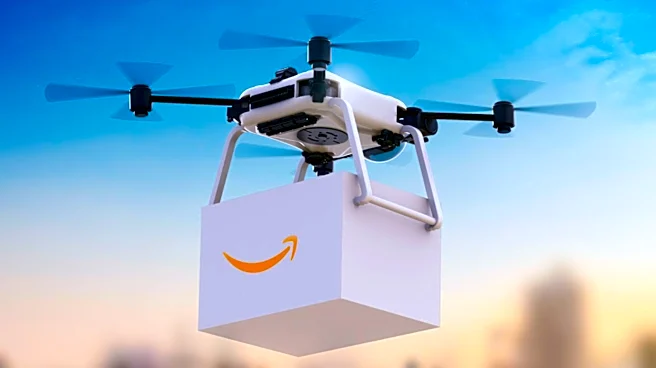
Global, with additional participation from notable firms including Valor Equity Partners, Fidelity Management & Research Company, Uber, Tiger Global, J.P. Morgan, ARK Invest, and Salesforce Ventures. Concurrently, Zipline has announced a major expansion of its partnership with Walmart. The new multi-year agreement will see the addition of 300 new drone delivery sites across the United States, a substantial increase from the current 21 active sites. Zipline plans to utilize the newly acquired funds to scale its U.S. manufacturing capabilities and expand its workforce to support the development of a nationwide drone delivery network. The company, founded in 2014, initially focused on delivering medical supplies in Africa before expanding its U.S. operations in 2020 and partnering with Walmart in 2021.
Why It's Important?
This significant investment and expanded partnership underscore a growing confidence in autonomous drone delivery as a viable and scalable logistics solution in the U.S. The $21.5 billion valuation positions Zipline as a major player in the last-mile delivery sector, signaling a potential shift in how goods are transported to consumers. For Walmart, the expansion to 300 drone delivery sites represents a substantial commitment to integrating advanced logistics technology into its retail operations. This move could enhance customer convenience, reduce delivery times, and potentially lower operational costs, giving Walmart a competitive edge in the e-commerce market. The broader adoption of drone delivery could also impact traditional logistics and transportation industries, potentially creating new job categories while altering existing ones. Furthermore, the expansion of U.S. manufacturing facilities by Zipline indicates a push towards domestic production in the burgeoning drone technology sector, contributing to job creation and technological advancement within the country.
What's Next?
Zipline is set to rapidly expand its U.S. manufacturing facilities and significantly increase its hiring to build out the nationwide drone delivery network. The immediate next steps involve the strategic deployment and operationalization of the 300 new drone delivery sites in collaboration with Walmart. This will likely involve securing necessary local permits, establishing infrastructure, and training personnel for the expanded operations. The company will also focus on further developing its drone delivery ecosystem, which includes aircraft, launch and landing systems, and logistics software, to support the increased volume and geographical reach. Competitors in the logistics and retail sectors will likely monitor Zipline's progress closely, potentially accelerating their own investments in drone delivery or similar autonomous technologies to keep pace with market innovations. Regulatory bodies, such as the Federal Aviation Administration (FAA), will continue to play a crucial role in overseeing the safe and efficient integration of this expanded drone network into national airspace.
Beyond the Headlines
The substantial expansion of Zipline's drone delivery network, backed by significant investment, points to a broader transformation in consumer expectations regarding delivery speed and convenience. This shift could normalize instant or near-instant delivery for a wider range of products, pushing traditional delivery services to innovate or risk obsolescence. Ethically, the increased presence of autonomous drones in residential areas may raise questions about privacy, noise pollution, and airspace management, prompting communities and regulators to establish new guidelines. Legally, the scaling of drone operations will necessitate continuous evolution of aviation regulations, liability frameworks, and local ordinances to ensure public safety and address potential conflicts. Culturally, the sight of drones regularly delivering goods could become commonplace, altering urban and suburban landscapes and influencing public perception of automation and technology in daily life. This development also highlights the growing convergence of retail, technology, and logistics, creating new business models and interdependencies across these sectors.