




What's Happening?
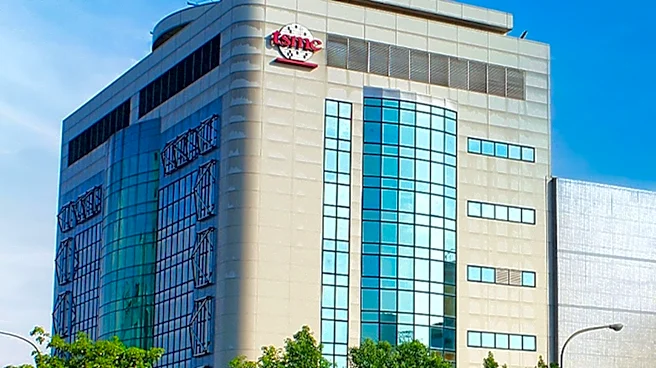
Taiwan Semiconductor Manufacturing Company (TSMC) is highlighted as the indispensable supplier for the world's leading-edge AI accelerators, including those from Nvidia. Despite Nvidia's higher valuation and faster revenue growth, every AI chip it ships
relies on TSMC's fabrication plants. TSMC's latest quarterly revenue grew by 41.2% year-over-year, reaching $46.72 billion, surpassing guidance. The company expects full-year 2026 growth of approximately 44%. Demand for AI chips continues to exceed TSMC's supply capabilities, with 79% of its wafer revenue coming from 7nm and below processes, indicating its control over the most valuable segments of the AI supply chain. Analysts maintain a strong positive outlook for TSMC, with a consensus price target of $584.39, citing its critical role in AI chip production and its current valuation of 18x forward earnings, which is considered a discount compared to its chip design clients.
Why It's Important?
TSMC's pivotal role in the AI supply chain underscores its strategic importance to the global technology industry. As the primary manufacturer of advanced AI chips, its capacity and technological advancements directly impact the growth and innovation of companies like Nvidia and Broadcom. The ongoing demand exceeding supply for TSMC's fabs indicates a bottleneck in the AI industry, where the ability to produce cutting-edge silicon dictates the pace of AI development. This concentration of manufacturing power in Taiwan also highlights geopolitical risks, as any disruption to TSMC's operations could have cascading effects across the global tech economy. For investors, TSMC represents a foundational investment in the AI boom, offering exposure to the underlying manufacturing process that powers the entire sector, often at a more conservative valuation compared to the chip designers it serves.
What's Next?
TSMC plans significant capital expenditures, reiterating a 2026 budget of $60 billion to $64 billion, with even higher spending projected for 2026-2028 to expand its capacity, particularly for 2nm and A14 nodes. The company expects N2 capacity to more than double by 2027, with A14 volume production scheduled for 2028. This aggressive expansion aims to meet the insatiable demand for AI accelerators. However, this growth comes with potential challenges, including margin dilution from overseas fabs, particularly as more U.S. capacity comes online, and geopolitical risks associated with its manufacturing concentration in Taiwan. The industry will closely monitor TSMC's execution on its roadmap, the stabilization of 2nm margins, and any shifts in hyperscaler capital expenditure, which could influence future demand for its advanced wafers.
Beyond the Headlines
TSMC's dominance in advanced semiconductor manufacturing has broader implications for national security and economic policy worldwide. The concentration of leading-edge chip production in Taiwan creates a single point of failure for the global technology supply chain, prompting nations like the U.S. to invest heavily in domestic chip manufacturing capabilities. This push for semiconductor independence aims to mitigate geopolitical risks and ensure a stable supply of critical components for AI, defense, and other strategic industries. The ongoing investment in new fabrication plants, while essential for meeting demand, also raises environmental concerns due to the significant energy and water consumption of these facilities. Furthermore, TSMC's technological leadership influences the competitive landscape of the entire tech industry, as access to its advanced processes can be a decisive factor in a company's ability to innovate and compete in the AI era.