
What's Happening?
Boom Supersonic has successfully conducted the first integrated core test of its Symphony engine, designed for the Overture supersonic airliner. The prototype Sprint Core, comprising the compressor, combustor,
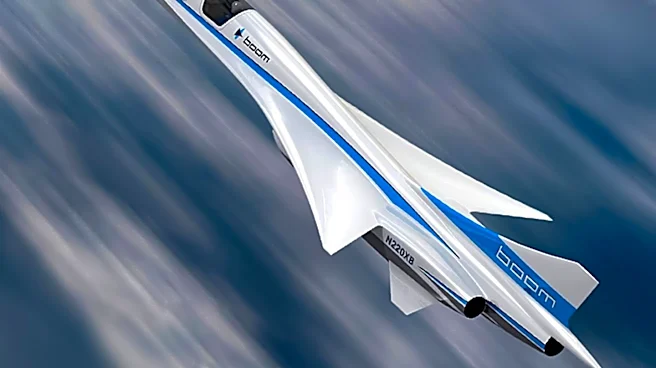
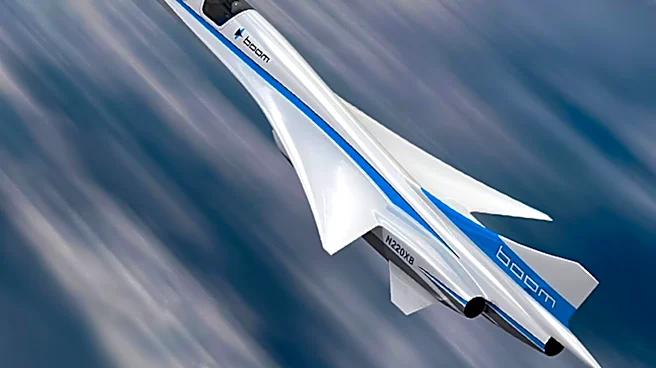
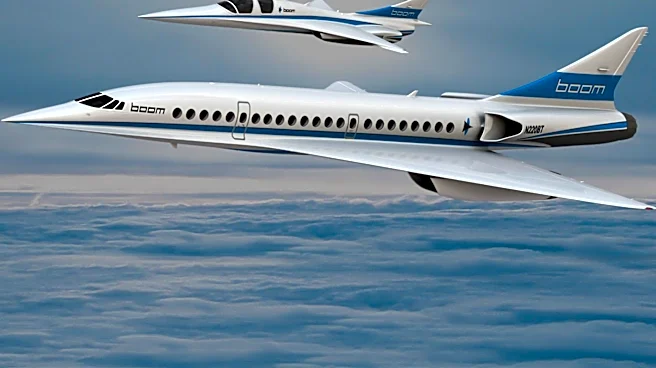
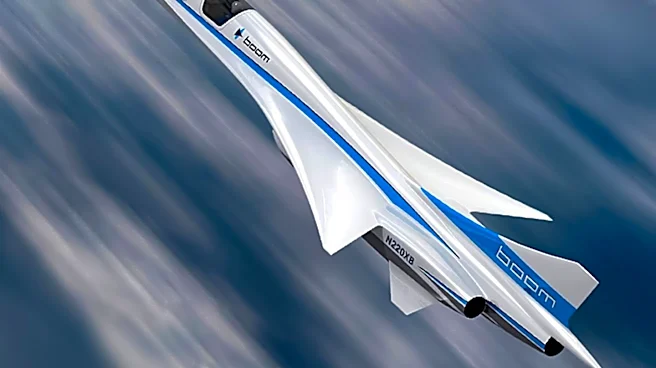
and high-pressure turbine, ran together for the first time on November 21, 2026, at the Colorado Air and Space Port in Watkins, Colorado. Approximately 2,000 sensors recorded critical data on temperature, pressure, and vibration during the test. This milestone was announced by Boom founder and CEO Blake Scholl. The Symphony engine is a medium-bypass turbofan optimized for supersonic flight, specifically for Boom's planned Mach 1.7 Overture airliner. The Sprint Core measures 12 feet long and 4 feet in diameter. This development follows Boom's XB-1 demonstrator's first supersonic flight in January 2025, as the company progresses towards the larger Overture, which has a reported backlog of orders and pre-orders from airlines including United Airlines and American Airlines.
Why It's Important?
This successful engine core test is a significant step forward for Boom Supersonic and the broader aerospace industry, marking progress towards reintroducing supersonic commercial air travel. The Overture airliner aims to become the world's fastest civilian aircraft, potentially revolutionizing long-haul travel by drastically reducing flight times. For U.S. airlines like United Airlines and American Airlines, who have already placed orders, this could offer a competitive advantage by providing premium, high-speed travel options to their customers. The development also has implications for U.S. manufacturing and technological innovation, showcasing advancements in aerospace engineering. Furthermore, the Symphony engine's core technology is also being adapted for Superpower, an industrial gas turbine targeting AI data centers from mid-2027, indicating potential diversification and broader economic impact beyond aviation. The success of this project could re-establish U.S. leadership in supersonic aviation, a field that has seen limited commercial activity since the Concorde.
What's Next?
To complete the Symphony turbofan, Boom Supersonic still needs to integrate the fan and low-pressure stages. Further core testing is scheduled before the engine moves into production and eventually seeks aircraft certification. The initial target for a full-scale core running was late 2025, indicating that the current milestone occurred approximately a year later than planned. The company will continue to work towards the larger Overture aircraft, which is designed to carry up to 88 passengers with a range of 4,890 miles. The Overture will be powered by three non-afterburning, medium-bypass turbofan engines. The progress of these subsequent development phases will be crucial for meeting the projected timelines for the Overture's commercial launch and fulfilling existing airline orders.
Beyond the Headlines
The re-emergence of supersonic commercial flight, spearheaded by companies like Boom Supersonic, could trigger a paradigm shift in global travel and business. Beyond the immediate benefits of reduced travel times, it could foster new economic corridors and enhance international connectivity, potentially impacting global trade and diplomacy. The ethical considerations around noise pollution and fuel efficiency for supersonic jets remain a subject of ongoing debate, requiring innovative solutions and regulatory frameworks. The dual application of the Symphony engine's core technology in industrial gas turbines for AI data centers highlights a broader trend of cross-industry technological transfer, where advancements in one sector can unexpectedly benefit another. This could lead to new efficiencies and capabilities in data infrastructure, underscoring the interconnectedness of modern technological progress.