



What's Happening?
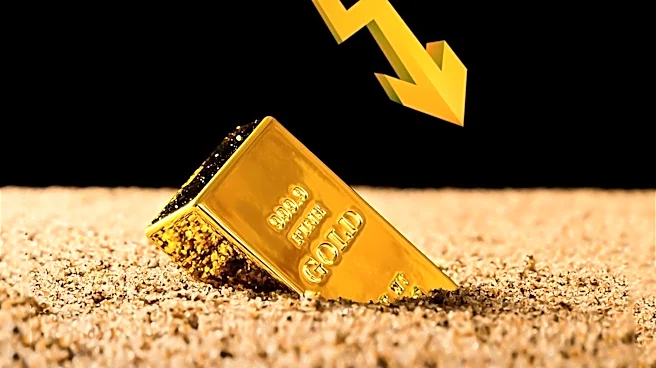
Goldman Sachs has revised its gold price forecasts downwards for year-end 2026 and 2027. The investment bank now projects gold to reach $4,150 per ounce by the end of 2026, a reduction from its previous estimate of $4,650. For year-end 2027, the forecast has been
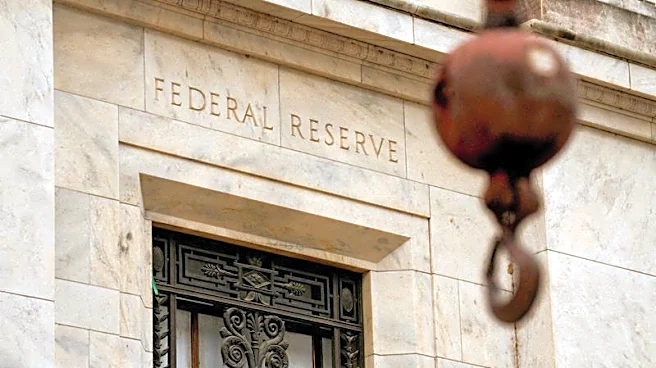
lowered to $4,800 per ounce from $5,400. This adjustment, according to Goldman Sachs strategists led by Lina Thomas, is primarily attributed to the Federal Reserve's recent hawkish shift in monetary policy. Despite these lowered short-term targets, Goldman Sachs maintains a constructive long-term outlook for gold, citing strong central bank buying as a key supportive factor. The current market environment for gold is noted to resemble 2022, where central bank demand provided a structural bid, but higher interest rates tempered investor positioning, leading to a more modest pace of price gains. Gold and silver have seen some momentum post-U.S. midterm elections, with spot gold up approximately 4% and spot silver over 5%.
Why It's Important?
This revised forecast from a major financial institution like Goldman Sachs signals a potential shift in market expectations for gold, impacting investors and financial markets. The Federal Reserve's hawkish stance, characterized by higher interest rates, typically makes non-yielding assets like gold less attractive compared to interest-bearing investments. This could lead to a reallocation of capital away from gold in the short to medium term, affecting gold mining companies, precious metals traders, and investors who use gold as a hedge against inflation or economic uncertainty. While central bank demand is expected to provide a floor for gold prices, the reduced forecasts suggest that this demand might not be enough to counteract the effects of a tighter monetary policy in the near future. Conversely, economist Peter Schiff offers a contrasting view, suggesting that increased government spending, regulation, larger budget deficits, and higher inflation under a Democratic-controlled Congress could be bullish for gold, indicating a divergence in expert opinions on gold's trajectory.
What's Next?
Goldman Sachs anticipates that central bank demand will continue to be the primary support for gold, projecting purchases of 60 tonnes per month through 2026 and 2027. The bank also expects further price support for gold once the Federal Reserve begins cutting interest rates, which they forecast to occur in the second half of 2027. Additionally, higher oil prices could introduce further pressure on gold through systematic selling. The ongoing debate between the impact of the Federal Reserve's monetary policy and potential inflationary pressures from government spending will likely continue to influence gold's performance. Investors will be closely monitoring economic indicators, Federal Reserve announcements, and geopolitical developments to gauge the future direction of gold prices. The conversation, according to Goldman, is shifting from whether to own gold to where to store it, highlighting broader concerns about reserve security and cross-country trust.