




What's Happening?
Honda is re-evaluating its vehicle strategy in North America, shifting its primary focus towards hybrid models. This strategic pivot includes plans to introduce 15 next-generation hybrid models globally by 2030, with a significant emphasis on the North American
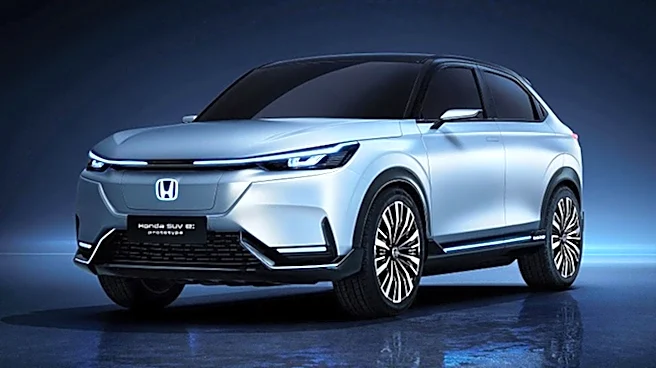
market. Production of the next-generation CR-V Hybrid has reportedly been delayed to April 2027. Concurrently, Honda has canceled three electric vehicle (EV) models intended for North America, including the Prologue, which is being discontinued after just over two years. Among the canceled EVs was the '0 SUV,' designed to compete with the Tesla Model Y. Despite its cancellation, a newly granted U.S. design patent closely resembling the '0 SUV' prototype has emerged, suggesting the design may still have future applications, though nothing is confirmed. Automakers frequently patent designs to protect intellectual property or for potential future use.
Why It's Important?
This strategic shift by Honda reflects broader trends and challenges within the U.S. automotive market, particularly the slowing demand for electric vehicles. By prioritizing hybrids, Honda aims to cater to current consumer preferences while still advancing towards more fuel-efficient options. This move could impact the competitive landscape of the U.S. auto industry, potentially increasing competition in the hybrid segment and altering the pace of EV adoption. For consumers, it means a wider array of hybrid choices from Honda, but fewer fully electric options. The cancellation of EVs and the delay in hybrid production could also affect Honda's market share and financial performance in the short to medium term, as it navigates this transition. The re-emergence of a canceled EV design in a patent highlights the dynamic nature of automotive development and intellectual property strategies.
What's Next?
Honda is expected to continue its rollout of 15 next-generation hybrid models globally by 2030, with a strong focus on the North American market. The delayed production of the CR-V Hybrid to April 2027 indicates that consumers will need to wait longer for this specific model. The future of the design seen in the newly granted U.S. patent, which resembles the canceled '0 SUV,' remains uncertain. While it could be a protective measure for intellectual property, it might also hint at a potential revival or adaptation of the design for a different vehicle, possibly a hybrid, given Honda's renewed focus. Industry observers will be watching to see how Honda's hybrid-centric strategy impacts its sales figures and market position in North America, especially as other manufacturers continue to invest in both EV and hybrid technologies.
Beyond the Headlines
Honda's strategic pivot underscores the complex challenges and uncertainties facing the automotive industry's transition to electrification. The slowing demand for EVs in the U.S. suggests that consumer readiness and infrastructure development are not progressing as rapidly as some automakers initially anticipated. This situation could lead other manufacturers to re-evaluate their own EV timelines and investment strategies, potentially resulting in a more diversified product offering that includes a stronger emphasis on hybrids. The decision also highlights the significant financial risks associated with large-scale EV development and the importance of market responsiveness. Furthermore, the use of design patents for canceled models illustrates how companies protect their innovations, even if immediate production plans change, maintaining options for future market shifts or technological advancements.