






What's Happening?
Dell Technologies shares experienced a nearly 5.9% decline in premarket trading on Tuesday, partially reversing a significant gain from the previous day. This downturn occurred as investors awaited the company's fiscal third-quarter 2027 financial results.
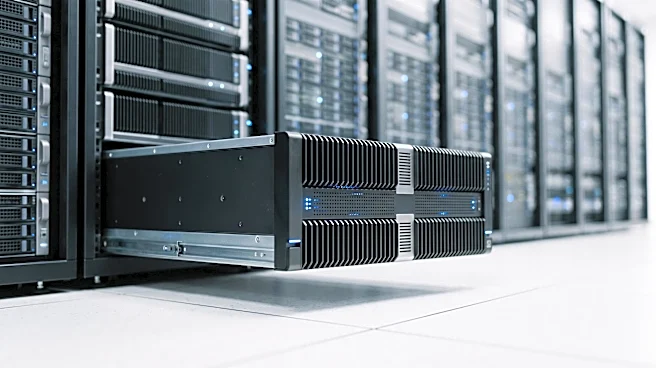
Key factors contributing to the cautious trading environment included concerns about profit margins on artificial intelligence (AI) servers, a weaker performance from rival Hewlett Packard Enterprise (HPE), and a broader decline across U.S. equity markets. Analysts had previously lowered price targets for Dell due to worries about the sustainability of AI infrastructure demand, increasing memory prices, and a weakening personal computer market. HPE's chief financial officer had also indicated potential for lower profit margins on AI server sales in the coming half-year, raising similar concerns for Dell.
Why It's Important?
The decline in Dell's stock, despite strong underlying demand for AI infrastructure, highlights investor sensitivity to profit margins and broader market sentiment. Concerns about AI server profit margins are critical because while AI hardware sales are booming, rising component costs, particularly for memory, could erode profitability. This situation creates uncertainty for investors who are evaluating whether Dell can translate record revenue levels into sustainable cash flow and earnings. The performance of competitors like HPE also influences investor perception, as similar challenges in the AI server market could affect Dell. Furthermore, the broader market weakness, driven by geopolitical concerns, adds another layer of caution, impacting investor appetite for technology and AI infrastructure stocks.
What's Next?
Investors will be closely scrutinizing Dell's official third-quarter fiscal 2027 financial results, particularly any guidance regarding AI server profit margins and the impact of rising memory prices. The company's ability to manage component costs and maintain profitability in its high-growth AI segment will be a key focus. Market participants will also monitor Dell's outlook on personal computer sales, which have shown signs of weakening. Any commentary from Dell's management regarding the sustainability of AI infrastructure demand and cash flow generation will be crucial. The broader market environment, including geopolitical developments and overall equity market trends, will continue to influence Dell's stock performance in the short term.
Beyond the Headlines
The current market reaction to Dell's stock reflects a broader investor dilemma within the technology sector: how to value companies benefiting from the AI boom when profitability might be constrained by supply chain costs and intense competition. This situation underscores the complex interplay between rapid technological adoption, supply chain dynamics, and investor expectations. Companies like Dell are at the forefront of enabling the AI revolution, but their financial performance is subject to the volatile costs of advanced components. This could lead to a re-evaluation of valuation metrics for AI hardware providers, shifting focus from pure revenue growth to sustainable profit generation and efficient cost management in a rapidly evolving market.