





What's Happening?
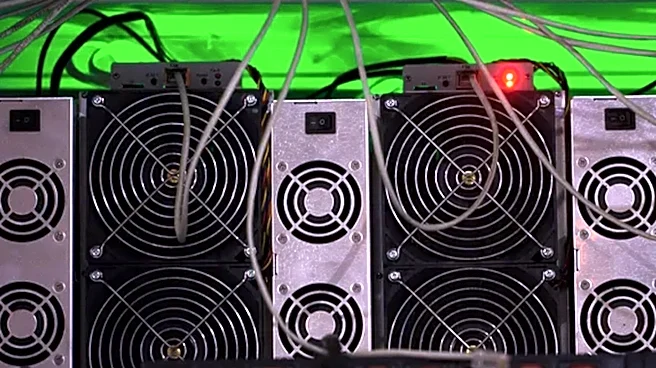
Maximizing profitability in ASIC Bitcoin mining depends on three primary factors: the cost of electricity, the efficiency of the mining hardware, and the fluctuating network difficulty. While solo Bitcoin mining successes are rare, consistent profitability for
independent miners is directly tied to these variables. Bitcoin's proof-of-work system means miners compete to find a valid block hash, with network difficulty adjusting approximately every two weeks (every 2,016 blocks) to maintain a block discovery rate of around ten minutes. Recent data indicates that network difficulty has significantly increased, impacting the revenue per terahash per second (TH/s). For instance, the Antminer S21 XP remains profitable even at higher electricity costs, while older or less efficient models quickly fall below the break-even point as power prices rise.
Why It's Important?
The profitability dynamics of Bitcoin mining have significant implications for individual miners and the broader cryptocurrency ecosystem. High electricity costs can render mining unprofitable, forcing less efficient operations offline and consolidating mining power among those with access to cheaper energy. The continuous increase in network difficulty, driven by more powerful hardware joining the network, means that miners must constantly upgrade their equipment to remain competitive. This creates a technological arms race, where older machines quickly become obsolete. Understanding these factors is crucial for anyone considering entering the Bitcoin mining space, as miscalculations in electricity costs or hardware efficiency can lead to substantial financial losses. The market rewards those who operate lean and efficient setups.
What's Next?
Miners are advised to regularly re-evaluate their profitability, especially after each bi-weekly difficulty adjustment. Key strategies for maximizing earnings include securing fixed-rate electricity contracts, exploring time-of-use plans, and utilizing the heat generated by miners in colder months to offset heating costs. For those with higher electricity rates, considering hosting services in locations with cheaper power can be a viable option. Furthermore, maintaining hardware efficiency through regular cleaning, monitoring real hash rates, and carefully tuning settings can prevent revenue loss. Miners must also develop a clear plan for their earnings, whether it involves selling enough to cover costs, holding Bitcoin, or reinvesting in more efficient equipment to sustain long-term profitability.
Beyond the Headlines
The evolving landscape of Bitcoin mining profitability highlights the intricate relationship between technological advancement, energy consumption, and economic viability. The increasing demand for efficient hardware and low-cost electricity underscores the environmental impact of proof-of-work cryptocurrencies, prompting ongoing debates about sustainable mining practices. The concentration of mining power in regions with cheap energy also raises questions about decentralization, a core tenet of Bitcoin. As the network difficulty continues to climb, the barrier to entry for individual miners increases, potentially leading to further industrialization of the mining sector. This trend could influence the future security and accessibility of the Bitcoin network, making it a domain primarily for large-scale operations rather than independent participants.