







What's Happening?
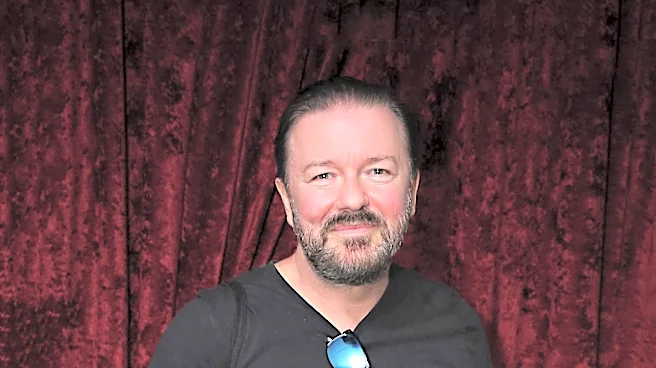
Ricky Gervais, the 65-year-old comedian and actor, is reportedly considering marrying his partner of 44 years, Jane Fallon, to protect his substantial property portfolio from a significant inheritance tax. Gervais, with an estimated net worth of $275
million (£141 million), owns a nine-bedroom mansion in Hampstead valued at $28.8 million (£14.75 million), two flats in New York, and a riverside estate in Marlow, Buckinghamshire, where he recently received approval to build a new $9.75 million (£5 million) mansion. Unmarried couples in the UK do not benefit from the same tax exemptions as married couples, meaning his estate would be subject to a 40% inheritance tax upon his death. Gervais, who previously stated that marriage was pointless, admitted in Saga Magazine that financial reality is the sole driver behind this potential decision.
Why It's Important?
This situation highlights a critical aspect of estate planning and inheritance laws, particularly for high-net-worth individuals in the UK, which can have implications for U.S. citizens with assets abroad. The 40% inheritance tax rate for unmarried couples underscores the financial incentives for marriage in certain jurisdictions, even for those who are philosophically opposed to the institution. For U.S. citizens holding assets in the UK, understanding these tax implications is crucial to avoid substantial financial losses. This scenario also brings to light the broader discussion around wealth transfer and tax policies, which can significantly impact individuals' financial legacies and influence personal decisions, such as marriage, for pragmatic reasons rather than purely emotional ones. It demonstrates how legal and financial frameworks can shape personal choices, even for public figures.
What's Next?
Gervais and Fallon have not yet married, but the comedian has indicated that it is a pragmatic step they will likely take. The decision comes amidst Fallon's recent breast cancer diagnosis, adding a layer of urgency to their estate planning. If they proceed with marriage, it would be a direct response to the UK's inheritance tax laws, ensuring that their shared wealth is protected for the surviving partner. This move could also spark further public discussion about inheritance tax policies and their impact on long-term unmarried partnerships, potentially influencing future legislative debates on tax equity for cohabiting couples in the UK and other countries with similar tax structures. The construction of their new mansion in Marlow is also underway, further solidifying their property assets.
Beyond the Headlines
Beyond the immediate financial implications, Gervais's decision to consider marriage for tax purposes delves into the societal and legal definitions of partnership and family. It challenges the romanticized notion of marriage, presenting it as a practical tool for financial protection in the face of legal disparities for unmarried couples. This situation could prompt a re-evaluation of how legal systems recognize and support long-term cohabiting relationships, especially concerning inheritance rights. It also highlights the tension between personal beliefs and financial realities, demonstrating how even deeply held convictions can be swayed by economic pressures. The public nature of Gervais's reasoning may encourage other long-term unmarried couples to consider the financial benefits of marriage, or conversely, advocate for reforms in inheritance laws to better accommodate diverse family structures.