





What's Happening?
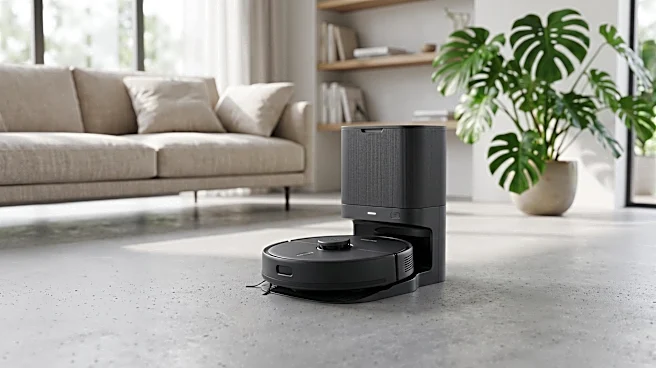
The Roborock Q7 M5+ robot vacuum and mop is being offered at a significant discount during Amazon's Black Friday sale, priced at $199.99, down from its list price of $359.99. This model includes a self-emptying dock that stores collected debris in a 2.7-liter
bag, which Roborock states can last up to seven weeks between changes. The robot utilizes LiDAR technology for precise floor mapping and boasts a suction power of 10,000Pa. The sale is part of Amazon's broader Black Friday event, which runs through November 30 and features discounts on various vacuum brands including Narwal, Ecovacs, iRobot, Tineco, Shark, and Bissell. Other notable deals include the Shark Navigator Lift-Away NV356E upright vacuum for $139.99 and the Bissell Revolution HydroSteam Pet carpet cleaner for $299.99. The Roborock Q7 M5+ is highlighted as a self-emptying option available for under $200, making advanced robot vacuum features more accessible.
Why It's Important?
The substantial discount on the Roborock Q7 M5+ makes advanced robot vacuum technology, including self-emptying capabilities and LiDAR navigation, highly accessible to U.S. consumers at a price point under $200. This affordability can significantly accelerate the adoption of smart home cleaning devices, allowing more households to experience the convenience of automated floor care. For the consumer electronics market, such aggressive pricing during Black Friday can drive considerable sales volume and market share for Roborock, while also intensifying competition among other manufacturers. The availability of self-emptying features at this price point sets a new benchmark for value, potentially influencing consumer expectations for entry-level and mid-range robot vacuums. This trend underscores the increasing commoditization of once-premium smart home features, making them mainstream.
What's Next?
The Black Friday sale is expected to generate high demand for the Roborock Q7 M5+ and other discounted robot vacuums. Following this period, manufacturers will likely analyze sales data to refine their pricing strategies and product offerings for future shopping events. The increased market penetration of robot vacuums with advanced features at lower price points could lead to further innovation, as companies strive to differentiate their products through enhanced AI, improved battery life, and more sophisticated cleaning mechanisms. Consumers can anticipate continued competitive pricing and feature-rich models as the smart home cleaning market matures. The success of these deals may also encourage retailers to offer similar deep discounts on other smart home gadgets throughout the holiday season.
Beyond the Headlines
The availability of a self-emptying robot vacuum with LiDAR navigation for under $200 signifies a broader trend in consumer technology: the rapid democratization of advanced features. What was once considered a luxury is now becoming a standard offering, making automated home maintenance accessible to a wider demographic. This shift has implications for daily life, potentially freeing up time for individuals and reducing the physical burden of household chores. It also highlights the intense competition within the smart home market, where companies are constantly pushing boundaries on price and features to capture consumer interest. However, this rapid turnover of technology also raises questions about product longevity, repairability, and the environmental impact of increased electronic waste. As these devices become more ubiquitous, discussions around their sustainability and the ethical implications of data collection (from home mapping) will likely become more prominent.