






What's Happening?
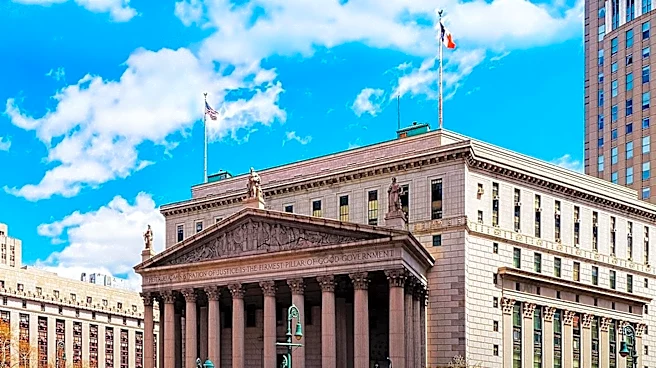
A Manhattan court is holding an emergency hearing today to consider a temporary restraining order (TRO) sought by New York Attorney General Letitia James against Kalshi, a prediction market exchange. Kalshi's legal team has warned that an unfavorable
ruling could force the nationwide shutdown of its services. The hearing follows federal rulings last week that returned New York's enforcement suit to state court. At stake is Kalshi's ability to offer its full product line, particularly event contracts related to sports, politics, and culture, within New York. If the court rules against Kalshi, the exchange would likely be compelled to geo-block these contracts in the state. Kalshi's co-founders, Tarek Mansour and Luana Lopes Lara, are also scheduled to appear in Utah on December 4th to face 13 felony counts related to unlawful gambling activity, highlighting the broader legal challenges prediction markets face across various states.
Why It's Important?
This court hearing is critical for the future of prediction markets in the U.S., particularly for Kalshi, which operates under federal regulation by the Commodity Futures Trading Commission (CFTC). A ruling in favor of the New York Attorney General could set a precedent, empowering other states to impose similar restrictions or outright bans on prediction market activities. This would significantly impact the nascent industry, potentially limiting consumer access to these platforms and stifling innovation in financial products. The legal battle underscores a fundamental disagreement between states, which often view prediction markets as unregulated gambling, and the prediction market operators, who assert their federal regulatory status. The outcome could determine whether prediction markets can operate freely across state lines or if they will face a patchwork of state-specific regulations, complicating their business models and growth prospects.
What's Next?
Following today's hearing, if Justice Melissa Crane issues an unfavorable ruling, Kalshi's immediate options would include seeking a temporary stay from Justice Crane herself or filing an emergency stay application with the state court's appellate division. Legal experts believe a full state-court appellate stay on the merits of the case is unlikely, though a partial carve-out to protect Kalshi's nationwide operations while maintaining state-enforced geo-restrictions remains a possibility. The broader conflict between states and prediction markets, and between states and the CFTC, appears to be escalating, with little room for compromise. With over 40 state attorneys general having signed open letters advocating for states' rights to regulate gambling, and Kalshi's co-founders facing felony charges in Utah, the legal landscape for prediction markets is becoming increasingly challenging and fragmented.
Beyond the Headlines
The legal challenges faced by Kalshi and other prediction markets highlight a deeper tension between federal and state regulatory authorities, particularly concerning emerging financial instruments that blur the lines between traditional finance and gambling. The outcome of these cases could have significant implications for how new technologies and financial products are regulated in the U.S., potentially leading to a more fragmented regulatory environment. This situation also raises questions about consumer access to innovative financial tools and the balance between protecting consumers from potential harms and fostering market innovation. The ongoing disputes could force a re-evaluation of existing laws and regulations, or even lead to new legislative efforts to clarify the legal status of prediction markets at both federal and state levels, impacting not only the companies involved but also the broader financial technology sector.